Understanding how credit score is calculated can help you make better decisions before applying for a credit card, auto loan, mortgage, or apartment. Your score is not random. A scoring model reviews information in your credit reports and estimates the risk that you may not repay a debt as agreed.
Payment history usually matters most. Credit card balances, account age, recent applications, and the types of credit you manage also play a role. However, the exact result can vary by scoring model, credit bureau, lender, and date.
This guide explains the five main FICO score factors, how credit utilization works, why your scores may differ, and what Florida consumers can do to build healthier credit. It also explains how to respond when inaccurate information appears on a credit report.
Quick answer: The simplest explanation of how credit score is calculated starts with five categories. FICO Scores generally consider payment history at 35%, amounts owed at 30%, length of credit history at 15%, new credit at 10%, and credit mix at 10%. These percentages describe the general population. The effect of any single action depends on the rest of your credit profile.
Key Takeaways
A credit score is calculated from information in a credit report. It is not the same as the report itself.
You can have many credit scores because lenders use different models, versions, and credit bureau data.
For FICO Scores, payment history and amounts owed have the greatest general influence.
Credit utilization has no single magic target. Lower reported revolving balances are generally better than high balances.
Income, savings, debit card use, and checking your own credit do not directly determine a standard credit score.
Accurate negative information cannot simply be erased. Inaccurate, incomplete, duplicated, or fraudulent information can be disputed.
What Is a Credit Score?
A credit score is a number that predicts credit risk. In practical terms, it helps a lender estimate how likely you are to repay borrowed money on time. Most commonly used consumer scores fall within a 300-to-850 range, although other ranges also exist.
A higher score may improve your chance of approval. It may also help you qualify for a lower interest rate, a higher credit limit, or more favorable terms. Still, a score never guarantees approval. Lenders can also review income, debt, assets, employment, loan type, down payment, and their own underwriting rules.
A lower score does not define your character or financial future. It reflects the information available to a scoring model at a specific time. As that information changes, your score can change too.
Credit Report vs. Credit Score
Your credit report is the detailed record. Your credit score is a number calculated from that record.
A report may show your credit cards, loans, payment history, credit limits, balances, account status, and inquiries. Equifax, Experian, and TransUnion maintain separate credit files. A lender or scoring company then applies a mathematical model to eligible information in one of those files.
Think of the report as the source material and the score as the summary. An error in the source material can affect the summary, which is why regular report reviews matter.
Why You Have More Than One Credit Score
You do not have one permanent credit score. You may have dozens of scores at the same time.
The number can differ because:
FICO and VantageScore use different formulas.
Each company offers several model versions.
Auto, mortgage, and credit card lenders may use industry-specific scores.
One lender may use Equifax data while another uses Experian or TransUnion.
Not every creditor reports to all three bureaus.
Balances and account updates may reach each bureau on different days.
Therefore, a score from a bank app may not match the score used for a mortgage application. That difference does not automatically signal an error. First, compare the scoring model, model version, bureau, and date.
How Credit Score Is Calculated: The Five Main FICO Factors
FICO groups the information used in its general scoring models into five categories. The percentages below show their relative importance for the general population. They are not a promise that one action will add or subtract a fixed number of points.
FICO score category
General weight
What it reviews
Payment history
35%
Whether accounts were paid as agreed, including delinquencies and serious negative events
Amounts owed
30%
Balances, revolving utilization, accounts with balances, and installment debt progress
Length of credit history
15%
Oldest account, newest account, average account age, and recent account activity
New credit
10%
Recent applications, hard inquiries, and newly opened accounts
Credit mix
10%
Experience with revolving and installment accounts
General FICO category weights. The importance of each factor can vary by consumer and scoring model.
1. Payment History: 35%
Payment history is generally the largest FICO category. It shows whether you paid credit accounts as agreed. Lenders care about this record because past repayment behavior can help predict future risk.
The category can consider:
on-time payments
30-, 60-, 90-, or more-day delinquencies
how recently a late payment occurred
how often late payments occurred
collections, charge-offs, foreclosures, and bankruptcies
the number of accounts paid as agreed
A recent serious delinquency may have more influence than an older isolated problem. However, the effect depends on your full credit profile. A person with a long, otherwise clean record may experience a different result than someone with several recent delinquencies.
The strongest practical step is simple: protect every due date. Set reminders or automatic minimum payments. Then pay more when your budget allows. Autopay can prevent an oversight, but you should still confirm that the payment processed and the account had enough funds.
2. Amounts Owed: 30%
Amounts owed is the second-largest general FICO category. It does not mean that having debt is automatically bad. Instead, the model looks at how much you owe and how that debt compares with your available credit or original loan amount.
This category may consider:
total balances across accounts
credit card utilization overall
utilization on each individual card
how many accounts carry balances
the remaining balance on installment loans
Revolving utilization often receives the most attention. A card near its limit can signal greater risk, even when every payment arrives on time. That is why paying down credit card balances can sometimes help sooner than paying extra on a low-rate installment loan. The best choice for your finances still depends on interest costs, cash flow, and your goals.
3. Length of Credit History: 15%
A longer credit history gives a scoring model more evidence about how you manage accounts. FICO may review the age of your oldest account, newest account, average account age, and the time since certain accounts were used.
Opening several accounts can lower the average age of your file. Closing an old card can also reduce available credit immediately. The closed account may remain on your reports for a period, so the effect on age is not always immediate.
Do not keep an expensive account open only for a score. First, ask whether the issuer can convert it to a no-fee option. Also review the account for fraud, fees, and inactivity rules.
4. New Credit: 10%
New credit includes recently opened accounts and hard inquiries. A hard inquiry usually occurs when you apply for credit and a lender reviews your file. Several new accounts in a short period may suggest higher risk, especially when your credit history is limited.
Hard inquiries can remain visible on a report for up to two years. Their scoring influence often fades sooner. In addition, FICO models may group eligible mortgage, auto, and student-loan inquiries made during a focused rate-shopping period. The exact treatment depends on the score version.
Prequalification and checking your own credit usually create soft inquiries. Soft inquiries do not affect standard credit scores.
5. Credit Mix: 10%
Credit mix describes your experience with different account types. Revolving accounts include credit cards and lines of credit. Installment accounts include mortgages, auto loans, student loans, and personal loans.
A varied history can help when you manage every account well. Still, credit mix is a smaller category. Do not borrow money, pay interest, or open a retail card only to create variety. A natural mix can develop as your needs change over time.
How Credit Utilization Really Works
Credit utilization explains an important part of how credit score is calculated. It compares revolving balances with revolving credit limits. It is part of the amounts-owed category and can change whenever lenders report new balances.
How to Calculate Credit Utilization
Use this formula:
Total reported revolving balances ÷ total revolving credit limits × 100 = utilization rate
For example, suppose you have two credit cards:
Card A: $1,000 balance and $4,000 limit
Card B: $500 balance and $6,000 limit
Your total balance is $1,500. Your total limit is $10,000. Therefore, your overall utilization is 15%.
Scoring models may also review each card. If Card A had a $3,800 balance on a $4,000 limit, its individual utilization would be 95%. That nearly maxed-out card could matter even if your overall utilization looked lower.
Is 30% Utilization Good?
Thirty percent is a common guideline, not an ideal target or a scoring cliff. Lower reported utilization is generally less risky than high utilization. Consumers with strong scores often report balances well below 30%.
However, you do not need to carry debt or pay interest to build a score. You can use a card, allow a small statement balance to report, and then pay the statement balance in full by the due date. Results vary, so avoid chasing a precise percentage at the expense of your budget.
When Credit Card Balances Get Reported
Many issuers report the statement balance once each billing cycle. As a result, a high balance may appear even when you pay the card in full by the due date.
Paying part of the balance before the statement closes may reduce the amount that gets reported. This strategy can help manage utilization, but it does not replace the need to pay on time. Learn more in our guide on when to pay a credit card bill.
What Does Not Affect Your Credit Score?
Knowing how credit score is calculated also helps separate scoring facts from common myths. A standard credit score focuses on credit report data. It does not measure your full financial life.
The following items do not directly determine a standard FICO Score:
Income or salary: A lender may consider income during underwriting, but income is not part of the FICO calculation.
Checking and savings balances: Money in a bank account does not normally appear in a traditional credit report.
Debit card use: A debit card spends money from your bank account. It does not create a credit repayment history.
Your age: A model may consider account age, but it does not score your age as a person.
Race, religion, national origin, sex, or marital status: These personal characteristics are not credit score factors.
Checking your own credit: A self-check is a soft inquiry and does not lower a standard score.
Rent and utilities that are not reported: On-time payments can affect a score only when eligible information reaches the credit file and the model uses it. Unpaid accounts may still affect credit if they enter collections.
Although these items do not directly determine the score, lenders may review other information when deciding whether you qualify. A credit score is only one part of underwriting.
Why Did My Credit Score Change?
Scores change when the information used by the model changes. They can also differ when a new model or credit bureau is used. Therefore, a movement of a few points may not signal a major problem.
Common Reasons Scores Drop
a higher credit card balance was reported
a payment became delinquent
a collection or charge-off appeared
you opened a new account
a lender made a hard inquiry
a credit limit decreased
you closed a card and raised overall utilization
an older account or favorable item left the report
incorrect or fraudulent information appeared
A drop does not reveal the cause by itself. Compare the current report with the previous version. Also review the score’s reason codes, which identify the factors that most affected that particular score.
an older negative item reached its reporting limit
No company can predict an exact increase from one action. Credit profiles differ, and score formulas evaluate the complete file.
How to Improve Your Credit Score
Once you understand how credit score is calculated, start with the factors that carry the greatest general weight. Then build a routine you can maintain. Consistency usually matters more than a temporary tactic.
1. Protect Your Payment History
Pay every credit account by its due date. At minimum, schedule the required payment. If you already missed a payment, bring the account current as soon as possible and keep it current.
Contact the creditor before you fall behind when possible. Some lenders offer due-date changes, hardship programs, or other arrangements. Get any agreement in writing and confirm how the account will be reported.
2. Lower Reported Credit Card Balances
Focus on cards with the highest utilization. Paying a nearly maxed-out card below a lower threshold may help your profile more than spreading the same payment evenly. However, consider interest rates and minimum payments too.
Do not spend more after receiving a credit limit increase. Otherwise, the extra limit may create more debt instead of lower utilization.
3. Review All Three Credit Reports
Visit AnnualCreditReport.com, the federally authorized source for reports from Equifax, Experian, and TransUnion. The site currently provides free weekly online reports.
Check names, addresses, account ownership, balances, limits, payment history, dates, and account status. Also look for duplicate collections or accounts you do not recognize.
4. Limit Unnecessary Credit Applications
Apply when the account supports a real goal. Before applying, review the lender’s general requirements and use prequalification when available. Prequalification is often a soft inquiry, although you should confirm the terms.
When rate shopping for an auto loan, mortgage, or student loan, complete comparisons within a focused period. Different score versions use different windows, so a shorter shopping period is safer.
5. Keep Older Accounts Open Thoughtfully
An older no-fee card can support available credit and account history. Still, security and cost come first. Close an account when fraud risk, fees, overspending, or poor terms outweigh the possible score benefit.
Before closing a card, pay down balances and review how the lost limit will affect utilization. You can also ask whether a product change is available.
6. Build Credit Without Unnecessary Debt
A secured credit card or credit-builder loan may help someone with a thin file. Compare fees, reporting practices, interest, and cancellation terms first. Confirm that the provider reports to the major credit bureaus.
You do not need to pay interest to build credit with a credit card. Small purchases and full, on-time statement payments can create positive history without revolving debt.
An inaccurate report can lead to an inaccurate score. You have the right to dispute information that is incorrect or incomplete. The Consumer Financial Protection Bureau recommends contacting both the credit reporting company and the company that furnished the information.
Use a clear process:
Download the report that shows the error.
Identify the exact account, field, date, or balance that is wrong.
Collect statements, letters, identity theft reports, or other supporting records.
Send a focused dispute to the bureau and the furnisher.
Keep copies, confirmation numbers, and delivery records.
Review the investigation result and updated report.
Do not dispute accurate information merely because it is negative. Most accurate negative payment information can generally remain for up to seven years, while bankruptcy information can remain longer in some cases.
Our guide on how to fix credit report errors explains how to document a problem and respond when a dispute does not resolve it.
Can Credit Repair Help?
You can review and dispute your credit reports yourself at no cost. However, some consumers prefer professional help when several reports contain complex errors, identity theft is involved, or previous disputes produced unclear results.
What Professional Credit Repair Can Do
A compliant credit repair service can help you:
organize reports from the three major bureaus
identify potentially inaccurate, incomplete, duplicated, or unverifiable reporting
prepare focused dispute correspondence
track responses and report changes
understand habits that support healthier credit over time
What Credit Repair Cannot Promise
No legitimate company can guarantee a specific score increase, deletion, approval, interest rate, or completion date. Accurate and current negative information cannot legally be removed simply because it is damaging.
Credit Repair of Florida focuses on credit report review, education, and the dispute of eligible inaccuracies. Learn more about our credit repair services.
Monitor Your Credit and Get a Free Consultation
Monitoring can help you notice new accounts, balance changes, inquiries, and possible identity theft sooner. It also gives you a record of how your reports change over time.
Credit Repair of Florida provides access to IdentityIQ credit monitoring information. Review the current features, price, cancellation terms, and partner disclosures before enrolling.
Not Sure What Is Affecting Your Credit?
Schedule a free credit consultation. We can help you review your credit reports, understand the information you see, and discuss practical next steps. Results vary, and no specific score increase or deletion is guaranteed.
Frequently Asked Questions
How is a credit score calculated?
A scoring model analyzes eligible information in a credit report. FICO generally groups that information into payment history, amounts owed, length of credit history, new credit, and credit mix. Other models may use similar data with different formulas and weights.
Which factor affects a credit score the most?
Payment history is the largest general FICO category at 35%. However, the effect of a late payment depends on its severity, recency, frequency, and the rest of the credit file.
Does checking my own credit lower my score?
No. Checking your own credit creates a soft inquiry, which does not lower a standard credit score. A lender’s review after a credit application may create a hard inquiry.
What credit utilization ratio should I target?
There is no universal perfect percentage. Lower reported revolving utilization is generally better than high utilization. Thirty percent is a guideline, not an ideal target or a guaranteed scoring threshold.
Why are my credit scores different?
Scores can differ because the model, model version, credit bureau, account data, and calculation date may differ. A lender may also use an industry-specific score that is not shown in a consumer app.
Does paying a collection improve my credit score?
It depends on the scoring model and the rest of your file. Some newer models ignore certain paid collections, while older models may still consider them. Paying a collection also does not automatically remove it from a report.
How often does a credit score update?
A score can change whenever a lender or service calculates it from updated report data. Creditors often report monthly, but they do not all report on the same date.
How long can a late payment stay on a credit report?
Negative payment history can generally remain on a credit report for up to seven years. Its scoring influence may lessen as it ages, especially when newer payments remain on time.
Does income affect a credit score?
Income is not part of a standard FICO Score. However, lenders may evaluate income and existing obligations to decide whether you can afford a new payment.
How quickly can I improve my credit score?
There is no fixed timeline. Lower reported card balances may affect a score after the next update, while recovery from late payments can take longer. The starting profile and the scoring model both matter.
Final Thoughts
Learning how credit score is calculated turns a confusing number into a practical action plan. First, protect payment history. Next, manage revolving balances. Then review all three credit reports, limit unnecessary applications, and allow positive history to grow.
Also remember that the score is not the complete financial picture. It does not measure income, savings, goals, or personal circumstances. It only summarizes certain credit report data through a particular model at a particular time.
When your reports contain questionable information, document the issue and use your dispute rights. When the process feels complex, a professional review may help you understand your options. Start with a free consultation with Credit Repair of Florida.
This article provides general educational information and is not legal, tax, or individualized financial advice. Credit scoring results and lender decisions vary.
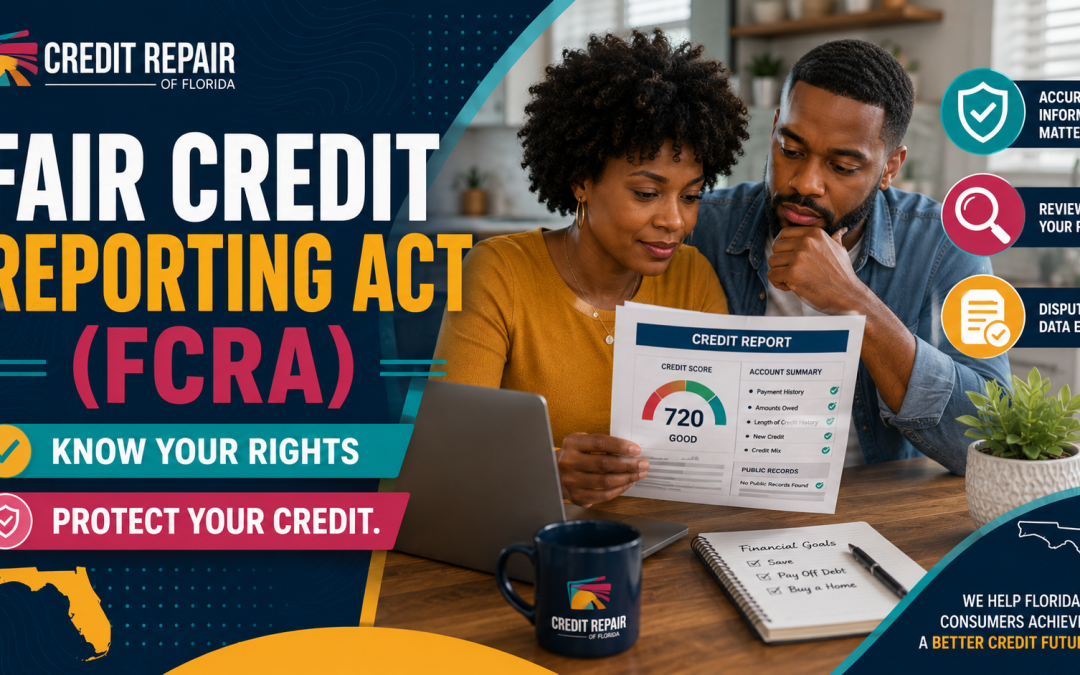
The Fair Credit Reporting Act (FCRA) promotes accuracy, fairness, and privacy in consumer credit reports and gives consumers the right to dispute inaccuracies.
The FCRA applies not only to major credit bureaus but also to banks, lenders, employers, and insurers.
Consumers can access their credit reports for free once a year and dispute inaccuracies they find.
Organizations handling credit information must follow procedures to ensure report accuracy and investigate disputes.
Understanding the FCRA helps consumers maintain accurate credit reports and navigate financial decisions effectively.
The Fair Credit Reporting Act (FCRA) is a federal law designed to promote the accuracy, fairness, and privacy of information contained in consumer credit reports. Whether you're applying for a mortgage in Miami, financing a vehicle in Tampa, renting an apartment in Orlando, or simply monitoring your financial health anywhere in Florida, the information in your credit report can significantly influence important financial decisions.
Unfortunately, credit reports are not immune to mistakes. Accounts may be reported incorrectly, payment histories can contain errors, balances may be inaccurate, or information belonging to someone else may appear on your file. Even small inaccuracies can affect your ability to qualify for loans, secure favorable interest rates, obtain insurance, or even pass an employment background screening when a credit report is legally considered.
Congress enacted the Fair Credit Reporting Act in 1970 to establish nationwide standards for how consumer credit information is collected, maintained, shared, and corrected. The law regulates credit reporting agencies, companies that furnish information to those agencies, and businesses that access consumer reports. It also gives consumers important rights to review their credit reports, dispute inaccurate information, and receive notice when adverse decisions are based on information contained in a credit report.
Understanding the FCRA is one of the best ways to become a more informed consumer. Knowing your rights can help you identify potential reporting errors, navigate the credit dispute process more effectively, and protect your financial reputation over time.
In this guide, we'll explain what the Fair Credit Reporting Act is, who must comply with it, the rights it provides, how the dispute process works, and what Florida consumers should know to help maintain accurate credit reports.
What Is the Fair Credit Reporting Act?
The Fair Credit Reporting Act (FCRA) is a federal consumer protection law codified primarily at 15 U.S.C. § 1681 et seq. Its primary purpose is to help ensure that consumer reporting agencies maintain credit information that is as accurate, complete, and private as reasonably possible.
The law applies to much more than the three nationwide credit bureaus—Equifax, Experian, and TransUnion. It also governs many businesses that collect, furnish, or use consumer credit information, including:
Banks
Credit unions
Credit card issuers
Mortgage lenders
Auto lenders
Collection agencies
Debt buyers
Consumer reporting agencies
Employers using credit reports for employment purposes (when legally permitted)
Insurance companies
Landlords and property management companies
The FCRA establishes rules for how these organizations may collect, report, access, investigate, and share consumer credit information. It also limits who may obtain your credit report by requiring a legally recognized permissible purpose before a report can generally be accessed.
Rather than guaranteeing perfect credit reports, the FCRA requires organizations to follow reasonable procedures that promote maximum possible accuracy while giving consumers meaningful opportunities to correct information they believe may be inaccurate or incomplete.
Why the Fair Credit Reporting Act Is Important
Your credit report influences far more than your credit score. Many financial institutions and businesses use information contained in your credit reports to evaluate risk before making important decisions.
An accurate credit report may help when applying for:
Mortgage loans
Auto financing
Personal loans
Credit cards
Apartment rentals
Utility services
Insurance policies
Employment opportunities where credit checks are permitted under applicable law
Conversely, inaccurate information may create unnecessary obstacles. For example, a credit report that incorrectly shows a missed payment, collection account, or higher-than-actual balance could affect lending decisions or result in less favorable loan terms.
The Fair Credit Reporting Act helps reduce these risks by requiring consumer reporting agencies and information furnishers to investigate disputes, correct verified inaccuracies when appropriate, and follow established procedures when handling consumer credit information.
For Florida consumers navigating competitive housing markets, rising insurance costs, or increasing borrowing expenses, maintaining an accurate credit report can play an important role in achieving financial goals.
Who Must Comply With the Fair Credit Reporting Act?
One common misconception is that the FCRA only applies to the three major credit bureaus. In reality, the law applies to several categories of organizations that participate in the consumer reporting process.
Consumer Reporting Agencies
Consumer reporting agencies collect and compile credit information from thousands of sources.
The three nationwide consumer reporting agencies include:
Equifax
Experian
TransUnion
These companies receive information from creditors, lenders, collection agencies, and public records, then organize it into consumer credit reports that eligible businesses may review when they have a permissible purpose.
Under the FCRA, consumer reporting agencies have numerous responsibilities, including following reasonable procedures to promote maximum possible accuracy, investigating consumer disputes, and providing consumers with access to their credit reports under applicable law.
Information Furnishers
Many businesses provide information to consumer reporting agencies. These organizations are commonly referred to as information furnishers.
Examples include:
Banks
Credit card companies
Mortgage servicers
Auto finance companies
Student loan servicers
Collection agencies
Debt purchasers
When furnishing information to consumer reporting agencies, these businesses are generally expected to report information accurately and investigate disputes that are forwarded by a consumer reporting agency in accordance with applicable FCRA requirements.
Businesses That Access Credit Reports
Many organizations lawfully obtain consumer reports when they have a permissible purpose under the FCRA.
Examples may include:
Mortgage lenders evaluating loan applications
Auto finance companies
Credit card issuers
Insurance companies underwriting policies
Landlords screening rental applicants
Employers conducting employment-related credit checks where permitted by law and with the required consumer authorization
The FCRA limits when consumer reports may be accessed and establishes rules regarding notices that consumers may receive when adverse decisions are based on information contained in a credit report.
What Information Does the Fair Credit Reporting Act Cover?
A consumer credit report contains numerous categories of financial information, many of which are protected by the Fair Credit Reporting Act's accuracy and dispute provisions.
Common information found in a credit report includes:
Personal Identifying Information
This section may include:
Full legal name
Previous names
Current and former addresses
Date of birth
Social Security Number (partially masked)
Employment information
Although identifying information generally does not affect your credit score directly, inaccuracies may sometimes contribute to mixed credit files or identity-related issues.
Credit Accounts
Credit reports typically contain information about both open and closed accounts, including:
Credit cards
Auto loans
Mortgages
Personal loans
Student loans
Home equity loans
Lines of credit
Reported account details may include balances, payment history, account status, credit limits, dates opened, and other information supplied by the creditor.
Collection Accounts
Accounts that have been placed with or sold to collection agencies may also appear on a consumer credit report.
These accounts often become the subject of consumer disputes when questions arise regarding account ownership, reporting accuracy, balance amounts, dates, or other factual information.
Public Record Information
Depending on current reporting practices and applicable law, certain public record information may appear in consumer reports where permitted.
Credit Inquiries
Credit reports generally distinguish between:
Hard inquiries, which may occur when applying for new credit and can affect credit scores under certain scoring models.
Soft inquiries, which commonly occur when you review your own credit report, receive pre-screened credit offers, or when existing creditors conduct account reviews. Soft inquiries generally do not affect credit scores.
Your Rights Under the Fair Credit Reporting Act
The Fair Credit Reporting Act gives consumers several important rights intended to promote fair, accurate, and transparent credit reporting. Understanding these rights can help you recognize when information may need to be corrected and what steps you can take if you believe your credit report contains inaccuracies.
While the FCRA provides important protections, it does not guarantee that every dispute will result in the removal of negative information. Instead, it establishes procedures that consumer reporting agencies and information furnishers must generally follow when handling consumer credit information.
The Right to Obtain Your Credit Reports
The FCRA gives consumers the right to access information contained in their credit reports.
Through AnnualCreditReport.com, the only website authorized by federal law for free credit reports from the nationwide consumer reporting agencies, you can review reports from:
Equifax
Experian
TransUnion
Reviewing your reports regularly allows you to:
Verify personal identifying information.
Confirm account balances and payment histories.
Check for unfamiliar accounts or inquiries.
Identify potential reporting errors before applying for new credit.
Monitor changes after submitting a dispute.
Many consumers only review their reports after being denied credit. However, checking your reports periodically can help identify potential inaccuracies before they affect an important financial decision.
The Right to Accurate Credit Reporting
One of the FCRA's primary objectives is to promote the maximum possible accuracy of consumer credit information.
Although the law recognizes that mistakes can occur, it requires consumer reporting agencies to maintain reasonable procedures designed to improve the accuracy of the information they report.
Examples of potentially inaccurate information include:
Incorrect account balances
Payment history errors
Duplicate accounts
Incorrect account status
Accounts belonging to another consumer
Incorrect dates associated with an account
Re-aged delinquent accounts
Incorrect personal identifying information
Not every difference between credit reports indicates an error. Some lenders report to only one or two credit bureaus, and updates may not appear simultaneously across all three nationwide consumer reporting agencies.
The Right to Dispute Information You Believe Is Inaccurate
If you believe information on your credit report is inaccurate or incomplete, the FCRA gives you the right to dispute that information.
Consumers may generally submit disputes to:
The consumer reporting agency reporting the information.
The company furnishing the information, when appropriate.
Providing documentation that supports your dispute may help the investigation process. Depending on the circumstances, this documentation could include account statements, payment records, identity documents, court records, or correspondence from a creditor.
Submitting a dispute does not automatically result in the deletion of an account. Instead, it begins a reinvestigation to determine whether the disputed information can be verified as accurate.
The Right to Receive Investigation Results
After completing a dispute investigation, the consumer reporting agency generally provides written or electronic notice of the results.
Depending on the outcome, the information may be:
Corrected
Updated
Deleted
Verified without changes
If changes are made, reviewing an updated credit report can help confirm that the corrections were applied accurately.
The Right to Be Notified of Adverse Actions
Sometimes a lender, landlord, insurer, or employer makes a decision based wholly or partly on information contained in a credit report.
Examples include:
Denying a loan application
Offering a higher interest rate
Denying rental housing
Increasing insurance premiums
Taking certain employment-related actions when permitted by law
When applicable, the FCRA generally requires the business to provide an adverse action notice explaining that information from a consumer report contributed to the decision. The notice also identifies the consumer reporting agency that supplied the report and informs consumers of certain rights under the FCRA.
The Right to Place Fraud Alerts and Security Freeze
Consumers who believe they may be victims of identity theft have additional protections under federal law.
Depending on the circumstances, consumers may choose to:
Place an initial fraud alert.
Request an extended fraud alert when eligible.
Freeze their credit reports to help prevent unauthorized credit applications.
A security freeze restricts access to your credit report for most new credit applications until you temporarily lift or remove the freeze.
The Right to Seek Legal Remedie
In certain circumstances, consumers may have the right to pursue legal remedies if the FCRA has been violated.
Because every situation is different, consumers with questions about potential legal claims should consult a qualified attorney regarding their specific circumstances.
How the Credit Report Dispute Process Works Under the FCRA
Many consumers assume that disputing information simply means asking a credit bureau to delete an account. In reality, the FCRA establishes a structured reinvestigation process designed to determine whether disputed information is accurate, complete, and verifiable.
Understanding each step can help you navigate the process more effectively.
Step 1: Review Your Credit Reports Carefully
Begin by obtaining copies of your credit reports from each nationwide consumer reporting agency.
Compare information across all three reports, paying close attention to:
Account balances
Payment history
Account status
Credit limits
Personal information
Collection accounts
Hard inquiries
Because creditors do not always report to every bureau, differences alone do not necessarily indicate inaccurate reporting.
Step 2: Identify Potential Inaccuracies
As you review your reports, note any information that appears inaccurate, incomplete, or inconsistent.
Examples may include:
Incorrect balances
Accounts reported more than once
Payments reported late despite records showing otherwise
Incorrect account status
Accounts that do not belong to you
Incorrect dates
Personal information that is not yours
Keeping organized notes will make it easier to prepare your dispute.
Step 3: Gather Supporting Documentation
Whenever possible, collect documents that support your position.
Examples include:
Bank statements
Cancelled checks
Payment confirmations
Account statements
Settlement agreements
Identity theft reports
Court documents
Written correspondence from creditors
Supporting documentation helps explain why you believe information may be inaccurate.
Step 4: Submit Your Dispute
Prepare a clear dispute identifying the specific information you believe should be investigated.
Your dispute should generally include:
Your identifying information.
The account being disputed.
The information you believe is inaccurate.
An explanation of why you believe it may be inaccurate.
Copies—not originals—of supporting documents.
Many consumers send disputes by certified mail with return receipt requested to create a record of delivery, while others choose to use the consumer reporting agency's online dispute process.
Step 5: The Investigation Begins
After receiving a dispute, the consumer reporting agency generally conducts a reinvestigation as required by the FCRA.
During this process, the bureau typically communicates the dispute to the information furnisher responsible for reporting the account.
The furnisher reviews the disputed information and responds based on its records.
Step 6: Review the Results
Once the investigation is complete, the consumer reporting agency provides the outcome.
Possible results include:
Information corrected
Information updated
Information deleted
Information verified as reported
Review the results carefully to determine whether additional action may be appropriate.
Step 7: Continue Monitoring Your Credit Reports
Even after a dispute has been resolved, continue monitoring your credit reports periodically.
Regular monitoring helps you:
Confirm corrections remain accurate.
Watch for future reporting changes.
Detect unfamiliar accounts.
Identify possible identity theft earlier.
Verify that updated information continues to be reported consistently.
Responsibilities of Consumer Reporting Agencies
The FCRA places significant responsibilities on consumer reporting agencies.
These responsibilities generally include:
Following reasonable procedures to promote maximum possible accuracy.
Conducting reinvestigations of eligible consumer disputes.
Correcting or deleting information when appropriate.
Providing consumers with access to their reports.
Limiting access to reports to parties with a permissible purpose.
Protecting the privacy of consumer information.
These requirements help establish consistency in how consumer credit information is maintained and shared.
Responsibilities of Information Furnishers
Credit reporting agencies are only one part of the reporting process. The companies that supply information also have important responsibilities.
Information furnishers generally should:
Report information accurately.
Update account information when appropriate.
Correct information found to be inaccurate.
Investigate disputes forwarded by consumer reporting agencies.
Report information consistently with applicable legal requirements.
Examples of furnishers include:
Banks
Credit unions
Mortgage lenders
Auto finance companies
Student loan servicers
Credit card issuers
Collection agencies
Debt buyers
Accurate reporting by furnishers plays an essential role in maintaining reliable consumer credit reports.
Common Credit Report Errors the FCRA Can Help Address
Although many credit reports are accurate, reporting errors can occur.
Common examples include:
Incorrect payment history
Duplicate accounts
Incorrect account balances
Accounts reported after identity theft
Incorrect credit limits
Incorrect personal identifying information
Accounts belonging to another consumer
Incorrect dates associated with an account
Collection accounts reported with inaccurate information
Incorrect account status, such as showing an account as open when it has been closed
If you discover information you believe may be inaccurate, reviewing the details carefully before submitting a dispute can help you present a clear and organized request for investigation.
Excellent. This final section is designed to improve topical authority and E-E-A-T while addressing common search intent. It also includes a comparison table that many competing articles lack, helping this page stand out in search results.
What the Fair Credit Reporting Act Does Not Do
Understanding what the Fair Credit Reporting Act (FCRA) does not do is just as important as understanding the protections it provides. Many consumers have misconceptions about the law, which can lead to unrealistic expectations during the credit repair process.
The FCRA promotes fair and accurate credit reporting, but it does not require credit reporting agencies or creditors to remove information simply because it is negative.
The FCRA does not:
Remove accurate negative information before the legal reporting period expires.
Eliminate legitimate debts that you owe.
Guarantee an increase in your credit score after submitting a dispute.
Require lenders to approve credit applications.
Prevent creditors from reporting truthful negative information.
Erase late payments that are accurate and verifiable.
Automatically delete collection accounts simply because they have been paid.
If an account is reported accurately, completely, and can be verified, it may continue appearing on your credit report for the period allowed by law.
How the Fair Credit Reporting Act Compares to Other Consumer Protection Laws
Several federal laws help protect consumers in different aspects of credit and debt. Understanding the differences can help you determine which law may apply to your situation.
Law
Primary Purpose
Fair Credit Reporting Act (FCRA)
Regulates how consumer credit information is collected, reported, shared, and disputed.
Fair Debt Collection Practices Act (FDCPA)
Governs how third-party debt collectors communicate with consumers and prohibits abusive, deceptive, or unfair collection practices.
Fair and Accurate Credit Transactions Act (FACTA)
Amends the FCRA by adding identity theft protections, fraud alerts, and free annual credit reports.
Fair Credit Billing Act (FCBA)
Protects consumers from certain credit card billing errors and establishes procedures for resolving billing disputes.
Credit Repair Organizations Act (CROA)
Regulates credit repair organizations and requires specific consumer disclosures while prohibiting deceptive practices.
Although these laws work together to protect consumers, each serves a different purpose. The FCRA specifically focuses on the accuracy, privacy, and fairness of consumer credit reporting.
Tips for Protecting Your Rights Under the FCRA
The best way to benefit from the Fair Credit Reporting Act is to stay proactive. Regularly reviewing your credit information and addressing potential issues early can help you maintain a more accurate credit history.
Consider these best practices:
Review your credit reports from all three nationwide consumer reporting agencies on a regular basis.
Compare information across your reports to identify inconsistencies.
Save important account statements and payment confirmations.
Keep copies of any correspondence related to disputes.
Respond promptly if you receive an adverse action notice.
Monitor your credit after resolving a dispute to ensure corrections remain accurate.
Consider placing a fraud alert or security freeze if you suspect identity theft.
Be cautious about sharing sensitive personal information online to reduce the risk of fraud.
Taking these steps can help you identify potential issues before they affect your ability to qualify for credit, housing, insurance, or employment opportunities.
Why Monitoring Your Credit Matters
Your credit report changes over time as lenders, creditors, and other information furnishers update account information. Even if your reports are accurate today, reviewing them periodically can help you detect changes that may require attention.
Regular credit monitoring can help you:
Identify unfamiliar accounts sooner.
Detect potential identity theft.
Monitor changes to account balances and payment history.
Verify corrections after a dispute has been completed.
Track improvements as you work toward your financial goals.
Monitoring your credit is not just about finding mistakes—it is also an effective way to stay informed about your overall financial health.
Conclusion
The Fair Credit Reporting Act is one of the most important consumer protection laws affecting your financial life. By establishing standards for the collection, reporting, and investigation of credit information, the FCRA helps promote greater accuracy, fairness, and privacy within the credit reporting system.
While no law can guarantee that every credit report will always be free of errors, the FCRA gives consumers meaningful rights to review their reports, dispute information they believe may be inaccurate, and receive the results of those investigations. Understanding these protections can help you make informed decisions and respond appropriately if you discover information that does not appear to be reported correctly.
If you've reviewed your credit reports and believe they contain inaccurate, incomplete, or unverifiable information, you don't have to navigate the process alone. At Credit Repair of Florida, we help consumers understand their credit reports, identify potential reporting concerns, and navigate the credit dispute process in accordance with applicable consumer protection laws.
Whether you're preparing to buy a home, finance a vehicle, qualify for better loan terms, or simply build a stronger financial future, maintaining an accurate credit report is an important step toward reaching your goals.
What is the purpose of the Fair Credit Reporting Act?
The Fair Credit Reporting Act is a federal law that promotes the accuracy, fairness, and privacy of consumer credit information. It establishes rules for consumer reporting agencies, information furnishers, and businesses that use credit reports while giving consumers the right to dispute information they believe may be inaccurate or incomplete.
Does the Fair Credit Reporting Act apply only to the three major credit bureaus?
No. The FCRA applies to consumer reporting agencies, information furnishers such as banks and credit card companies, collection agencies, debt buyers, employers that obtain credit reports when legally permitted, landlords, insurers, and other businesses that use consumer reports for a permissible purpose.
How long does a credit bureau generally have to investigate a dispute?
In many cases, the FCRA requires consumer reporting agencies to complete a dispute investigation within 30 days after receiving the dispute. Certain circumstances, such as the submission of additional relevant information during the investigation, may affect this timeframe.
Can accurate negative information be removed under the FCRA?
Generally, no. The FCRA does not require the removal of information that is accurate, complete, and verifiable simply because it is negative. However, if information cannot be verified or is determined to be inaccurate, it may be corrected or removed as appropriate.
Can I dispute information directly with a creditor?
Yes. Depending on the situation, consumers may dispute information with a consumer reporting agency, the company furnishing the information, or both. The most appropriate approach depends on the circumstances and the type of information being disputed.
Will filing a dispute improve my credit score?
Submitting a dispute alone does not increase your credit score. Any change in your score depends on the outcome of the investigation and whether information on your credit report is corrected, updated, or removed.
How often should I review my credit reports?
Many financial professionals recommend reviewing your credit reports regularly, especially before applying for a mortgage, auto loan, apartment rental, or other significant financial obligation. Routine reviews can help you identify potential inaccuracies or signs of identity theft earlier.
Where can I obtain my free credit reports?
You can request free credit reports from Equifax, Experian, and TransUnion through AnnualCreditReport.com, the only website authorized by federal law to provide free annual credit reports from the nationwide consumer reporting agencies.
Last updated: June 5, 2026 In this article, we’ll explain What Is a Credit Report and why it matters for your financial health.
Estimated reading time: 16 minutes
Key Takeaways
A credit report is a detailed record of your credit history, used by lenders and landlords to assess your financial responsibility.
Understanding your credit report helps identify errors, monitor progress, and protect against identity theft.
Federal law entitles you to dispute inaccurate information on your credit report and obtain free copies from authorized sources.
Different credit bureaus may have slightly different reports due to varying reporting practices from lenders.
Regularly reviewing your credit report can help maintain a healthy credit profile and prevent potential issues.
What is a credit report, and why does it matter? It is an important document that summarizes your credit history and shows how you manage debt and financial obligations. Whether you are applying for a mortgage in Miami, financing a vehicle in Tampa, renting an apartment in Orlando, or opening your first credit card anywhere in Florida, your report can play an important role in the decision-making process.
Many consumers confuse a credit report with a credit score. Although they are closely related, they are not the same thing. Your credit report contains the information lenders, landlords, insurers, and other authorized parties use to evaluate your credit history. Your credit score is simply a numerical interpretation of much of the information contained in that report.
Understanding your report is one of the most important steps you can take toward protecting your financial future. It helps you identify reporting errors, recognize signs of identity theft, monitor your financial progress, and make informed borrowing decisions. Even small inaccuracies can affect your ability to qualify for loans, obtain favorable interest rates, or secure housing.
Federal law also gives you important rights regarding your credit information. You have the right to review your credit reports, dispute inaccurate information, and expect consumer reporting agencies to conduct reasonable investigations when legitimate disputes are submitted.
This guide explains everything Florida consumers should know about credit reports, including what they contain, who creates them, who can access them, how to read them, common reporting errors, and what to do if you discover inaccurate information.
What Is a Credit Report?
A credit report is a detailed record of your credit history. It summarizes how you have used credit over time and provides information about your borrowing habits, payment history, and current credit accounts.
Credit reports are maintained by nationwide consumer reporting agencies, commonly known as credit bureaus. The three largest credit bureaus in the United States are:
Equifax
Experian
TransUnion
These companies collect information from lenders, credit card issuers, banks, finance companies, collection agencies, and other businesses that furnish credit data. They organize this information into individual credit reports that authorized users may review when evaluating credit applications or other financial decisions.
A credit report is not a judgment about your financial responsibility. Instead, it serves as a historical record of information that has been reported about your credit accounts.
Because lenders do not always report information to every credit bureau, each bureau may maintain a slightly different report for the same consumer.
Why Your Credit Report Matters
Your credit report affects far more than loan applications. Many important financial decisions rely on the information it contains.
A strong and accurate report may help you:
Qualify for mortgages
Obtain lower interest rates
Finance vehicles
Receive higher credit limits
Rent apartments
Reduce security deposits for utilities
Qualify for certain insurance discounts
Access business financing
Conversely, inaccurate information or legitimate negative information may make these opportunities more difficult or expensive.
For Florida consumers navigating competitive housing markets and rising living costs, maintaining an accurate credit report can have a meaningful financial impact.
Who Creates Credit Reports?
The three nationwide consumer reporting agencies each create and maintain their own credit reports.
Equifax
Equifax maintains consumer credit files using information received from thousands of businesses across the country. Lenders may use Equifax reports when evaluating applications for mortgages, auto loans, credit cards, and personal loans.
Experian
Experian is another major credit bureau that maintains consumer credit files and shares credit reports with businesses that have a permissible purpose under the Fair Credit Reporting Act (FCRA). Because some lenders send account updates to Experian but not to every other bureau, your Experian report may show information that differs from your Equifax or TransUnion reports.
TransUnion
TransUnion collects similar credit information but maintains its own independent database.
A lender may report to TransUnion, Experian, or Equifax, or to all three bureaus. As a result, account balances, payment histories, reporting dates, and account statuses sometimes vary among your reports.
Why Your Three Credit Reports May Be Different
Many consumers worry when they notice differences among their credit reports.
In most cases, these differences are completely normal.
Some common reasons include:
Not Every Creditor Reports to Every Bureau
A lender may choose to report only to Experian and TransUnion but not Equifax.
Reporting Dates Differ
Creditors update accounts at different times throughout the month.
One bureau may receive updated information before another.
Different Account Histories
Some lenders began reporting to certain bureaus before others.
Older account history may therefore vary.
Processing Times
Updates submitted by creditors are not always processed simultaneously.
A payment that appears today on one report may not appear on another for several days or weeks.
What Information Is Included in a Credit Report?
Although formats vary slightly among the credit bureaus, most reports contain similar categories of information.
Personal Information
Your report may include:
Full legal name
Previous names
Current address
Previous addresses
Date of birth
Social Security Number (partially masked)
Current and previous employers
This information helps identify your file but generally does not affect your credit scores directly.
Credit Accounts
The largest section of your report lists your credit accounts.
Examples include:
Credit cards
Mortgages
Auto loans
Student loans
Personal loans
Retail financing accounts
Home equity loans
Lines of credit
Each account typically displays:
Creditor name
Account number (partially masked)
Date opened
Account type
Credit limit
Original loan amount
Current balance
Payment status
Account status
Date last reported
Payment History
Payment history is one of the most significant sections of your credit report.
It generally shows whether payments were made on time or reported late.
Late payments may appear in categories such as:
30 days late
60 days late
90 days late
120 days late
150 days late
Charge-off
Accurate payment history can remain on your report for years and may influence your credit scores.
Credit Inquiries
Your report may also include inquiries showing who has accessed your credit information.
Hard Inquiries
Hard inquiries usually occur when you apply for new credit.
Examples include:
Mortgage applications
Auto loans
Credit cards
Personal loans
Hard inquiries may affect your credit score for a limited period.
Soft Inquiries
These types of inquiries occur for purposes such as:
Checking your own credit report
Pre-approved credit offers
Employment screening (when authorized)
Account reviews by existing creditors
Unlike hard inquiries, soft inquiries do not affect your credit score.
Collection Accounts
If an unpaid debt has been assigned or sold to a collection agency, that information may appear on your credit report.
Collection accounts may remain for several years depending on applicable reporting rules.
However, not every collection account is accurate. Consumers sometimes discover duplicate reporting, incorrect balances, inaccurate dates, or accounts that do not belong to them.
Public Records
Certain public records, such as bankruptcies, may appear on your credit report.
Many other public records that were once commonly reported, such as most civil judgments and tax liens, generally no longer appear on standard consumer credit reports due to changes in reporting practices.
Consumer Statements
Some credit bureaus allow consumers to add brief statements explaining certain circumstances.
These statements generally do not improve credit scores, but they may provide additional context for future manual reviews.
What Is NOT Included on a Credit Report?
Many consumers assume their report contains every detail about their finances. In reality, credit reports are designed to show information related to your credit history—not every aspect of your financial life.
Generally, your report does not include:
Your income or salary
Bank account balances
Retirement or investment accounts
Race or ethnicity
Religion
Political affiliation
Marital status (in most cases)
Medical records
Criminal history
Utility payments that are not reported to the credit bureaus
Rent payments unless your landlord or a rent-reporting service reports them
Some information, such as rent or utility payments, may appear if you voluntarily enroll in eligible reporting programs or if a provider reports that information to one or more credit bureaus.
Understanding what belongs on a report can help you recognize information that may be inaccurate or irrelevant.
Credit Report vs. Credit Score
Although people often use these terms interchangeably, they represent two different things.
Credit Report
Credit Score
A detailed record of your credit history
A three-digit number calculated from information in your credit report
Created by Equifax, Experian, and TransUnion
Calculated using scoring models such as FICO® Score or VantageScore®
Lists your accounts, balances, payment history, inquiries, and public records
Predicts credit risk based on the information in your credit report
May contain hundreds of pieces of information
Usually ranges from 300 to 850
Used to generate credit scores
Used by lenders as one factor when evaluating applications
Your credit score is based largely on the information in your report. If the report contains inaccurate information, your score could also be affected.
For a deeper explanation, read our guide on FICO® Score vs. VantageScore®.
Who Can Legally Access Your Credit Report?
The Fair Credit Reporting Act (FCRA) limits who may access your credit report. Businesses generally must have a permissible purpose to obtain your information.
Examples of organizations that may have a permissible purpose include:
Banks
Mortgage lenders
Credit card companies
Auto finance companies
Landlords
Insurance companies
Existing creditors reviewing your accounts
Collection agencies
Government agencies when authorized by law
Employers (with your written permission in many situations)
Friends, neighbors, employers without authorization, or unrelated businesses cannot simply request your report out of curiosity.
If you notice an inquiry from a company you do not recognize, you may want to determine whether it had a permissible purpose to access your information.
How to Get Your Free Credit Report
Federal law allows consumers to obtain free copies of their reports from the three nationwide consumer reporting agencies.
This website is authorized by federal law to provide free credit reports from:
Equifax
Experian
TransUnion
Reviewing your own credit report does not lower your credit score because it creates only a soft inquiry.
Many consumers benefit from reviewing their reports regularly to identify errors, monitor account activity, and detect identity theft early.
How to Read Your Credit Report
A credit report may seem overwhelming at first glance, but reviewing it section by section makes the process much easier.
Step 1: Verify Your Personal Information
Start by confirming that your identifying information is accurate.
Review your:
Name
Current address
Previous addresses
Date of birth
Employer information
An unfamiliar address or employer may simply reflect outdated information, but it could also indicate that your file has been mixed with someone else's or that fraudulent activity has occurred.
Step 2: Review Every Credit Account
Examine each account individually.
Verify the:
Creditor name
Date opened
Account status
Credit limit
Current balance
Payment history
Date last reported
Compare this information with your own records whenever possible.
Step 3: Check Payment History
Payment history is one of the most important sections of your report.
Look for:
Incorrect late payments
Missing on-time payments
Duplicate delinquencies
Incorrect account status
Payments reported after an account was closed
Even a single inaccurate late payment may deserve further review.
Step 4: Review Credit Inquiries
Confirm that you recognize every hard inquiry.
If you do not remember applying for credit with a particular company, consider contacting the lender to determine why the inquiry occurred.
Step 5: Examine Collection Accounts
If collection accounts appear, review:
Balance
Original creditor
Dates
Account status
Consumers sometimes discover duplicate collections, incorrect balances, or collection accounts that belong to someone else.
Step 6: Compare All Three Credit Reports
Because Equifax, Experian, and TransUnion maintain separate databases, reviewing only one report may not reveal every issue.
Comparing all three reports helps identify inconsistencies and determine whether information is being reported differently across the credit bureaus.
Common Credit Report Errors
Although many reports are accurate, mistakes do occur.
Some of the most common errors include:
Incorrect Personal Information
Examples include:
Wrong address
Misspelled name
Incorrect Social Security Number
Mixed credit files
Accounts That Do Not Belong to You
Identity theft or mixed files may result in accounts appearing that you never opened.
Incorrect Payment History
Examples include:
Payments reported late even though they were made on time
Duplicate late payments
Incorrect delinquency dates
Incorrect account status
Incorrect Balances
A creditor may report an outdated balance or payment amount.
This could make it appear that you owe more than you actually do.
Duplicate Accounts
Occasionally, the same debt appears more than once.
Duplicate reporting may create the impression that you owe more money than you actually owe.
Incorrect Account Status
Examples include:
Closed accounts reported as open
Open accounts reported as closed
Paid accounts still showing a balance
Accounts reported as charged off after being resolved
Fraudulent Accounts
Identity theft may result in unfamiliar accounts, inquiries, or collection accounts appearing on your report.
Prompt action can help minimize the impact if you discover unauthorized activity.
How to Dispute Credit Report Errors
If you believe information on your report is inaccurate, incomplete, or cannot be verified, federal law provides a process for disputing that information.
Gather Supporting Documentation
Collect any records that support your position, such as:
Account statements
Payment confirmations
Letters from creditors
Identity documents
Court records, when applicable
The stronger your documentation, the easier it may be for the credit bureau to investigate your dispute.
Submit Your Dispute
You can generally submit disputes:
Online
By mail
In some cases, by telephone
Many consumers choose certified mail because it provides proof that the dispute was received.
When appropriate, you may also send a direct dispute to the company furnishing the information, not just the credit bureau.
Wait for the Investigation
Under the Fair Credit Reporting Act, consumer reporting agencies generally have 30 days to investigate most disputes after receiving them, although the timeline may vary in certain circumstances.
During the investigation, the bureau contacts the company that furnished the information and asks it to verify the accuracy of the disputed item.
Review the Results
After the investigation is complete, the credit bureau will provide the results.
If information cannot be verified or is found to be inaccurate, it may be corrected or removed.
If the information is verified, it may remain on your credit report. You should carefully review the investigation results and decide whether additional documentation or further action is appropriate.
Continue Monitoring Your Reports
After a dispute is resolved, obtain updated copies of your credit reports to confirm that any corrections have been made accurately.
Monitoring your reports can also help you identify any future reporting issues or potential identity theft.
How Long Does Information Stay on Your Credit Report?
Not all information remains on your credit report indefinitely. The Fair Credit Reporting Act (FCRA) establishes general limits on how long many types of negative information may be reported. These reporting periods typically begin from specific events, such as the date of the first delinquency for many charged-off or collection accounts.
The following table provides general reporting timeframes.
Type of Information
Typical Reporting Period*
Hard inquiries
Up to 2 years
Late payments
Up to 7 years
Collection accounts
Up to 7 years from the date of first delinquency
Charge-offs
Up to 7 years from the date of first delinquency
Foreclosures
Up to 7 years
Repossessions
Up to 7 years
Chapter 13 bankruptcy
Up to 7 years
Chapter 7 bankruptcy
Up to 10 years
*These are general guidelines. Certain exceptions may apply under federal law.
It is important to understand that accurate negative information generally cannot be removed simply because it is hurting your credit score. However, information that is inaccurate, incomplete, or cannot be verified may be eligible for correction or removal through the dispute process.
How to Help Keep Your Credit Report Healthy
Although no one can control every financial circumstance, several habits can help maintain an accurate and healthy report over time.
Review Your Credit Reports Regularly
Many financial experts recommend reviewing all three credit reports several times each year.
Pay Bills on Time
Payment history is one of the most influential factors used by many credit scoring models.
Making payments on time consistently may help strengthen your overall credit profile over the long term.
If you believe a late payment has been reported inaccurately, compare it with your own records before deciding whether to dispute it.
Checking your credit reports allows you to identify errors, monitor your accounts, and detect signs of identity theft before they become larger problems.
Keep Credit Card Balances Manageable
Your credit utilization ratio compares your revolving balances with your available credit limits.
Although there is no single utilization percentage that guarantees a particular credit score, consistently using a large portion of your available revolving credit may affect many scoring models.
Apply for New Credit Thoughtfully
Each application for new credit may result in a hard inquiry.
While occasional inquiries are generally expected, applying for several new accounts within a short period may affect your credit profile.
Before submitting an application, consider whether the new credit is necessary and whether it aligns with your financial goals.
Monitor for Identity Theft
Identity theft can result in unauthorized accounts, fraudulent inquiries, or inaccurate personal information appearing on your credit reports.
Review your reports carefully and investigate unfamiliar activity promptly.
You may also consider placing a fraud alert or security freeze on your credit files if you suspect identity theft.
When Should You Consider Professional Credit Repair?
Many consumers successfully review their own credit reports and dispute information they believe is inaccurate.
However, others choose to seek professional assistance when:
They find multiple reporting errors across different credit bureaus.
Their reports contain complex account histories.
They are unsure how to prepare effective disputes.
They want help organizing documentation and monitoring investigation results.
They have limited time to manage the dispute process themselves.
A reputable credit repair company should review your reports carefully, explain your rights under federal law, and help identify information that may warrant further investigation.
Be cautious of any company that:
Promises to remove accurate negative information.
Guarantees a specific credit score increase.
Claims it can create a new credit identity.
Promises results within a specific number of days.
Under the Credit Repair Organizations Act (CROA), legitimate credit repair companies must provide certain disclosures and cannot make misleading claims about the services they offer.
Frequently Asked Questions
What is a credit report?
A credit report is a record of your credit history maintained by consumer reporting agencies such as Equifax, Experian, and TransUnion. It typically includes information about your credit accounts, payment history, balances, inquiries, and certain public records.
Is a credit report the same as a credit score?
No. A credit report contains detailed information about your credit history, while a credit score is a three-digit number calculated using information from your report. Lenders often review both when evaluating applications.
How can I get my credit report for free?
You can obtain free credit reports from the three nationwide consumer reporting agencies through AnnualCreditReport.com, the official website authorized under federal law.
Does checking my own credit report lower my credit score?
No. Reviewing your own report creates a soft inquiry, which does not affect your credit score.
Why are my three credit reports different?
Not every lender reports information to all three credit bureaus, and updates may occur at different times. As a result, your Equifax, Experian, and TransUnion reports may contain slight differences.
Can I dispute inaccurate information on my credit report?
Yes. If you believe information is inaccurate, incomplete, or cannot be verified, you have the right to dispute it with the credit bureau and, when appropriate, directly with the company that furnished the information.
Can accurate negative information be removed from my credit report?
Generally, no. Accurate negative information usually remains for the reporting period established by federal law. However, inaccurate or unverifiable information may be corrected or removed after a proper investigation.
How often should I review my credit report?
Reviewing your reports regularly can help you detect errors, monitor changes, and identify potential identity theft. Many consumers choose to review all three reports several times each year.
Conclusion
Your credit report is much more than a list of accounts. It is one of the primary tools lenders, landlords, insurers, and other authorized organizations use to evaluate your credit history and financial responsibility.
Understanding what appears on your report—and reviewing it regularly—can help you identify reporting errors, monitor your financial progress, and detect potential identity theft before it causes significant problems.
If you discover information that appears inaccurate, incomplete, or cannot be verified, federal law provides important rights that allow you to dispute that information with the appropriate consumer reporting agency and, when applicable, the company that furnished the data.
If reviewing your reports feels overwhelming or you need assistance understanding complex reporting issues, the team at Credit Repair of Florida can help you evaluate your credit reports, explain your options, and determine whether professional credit repair services may be appropriate for your situation.
A good credit score generally starts around 670 under many FICO scoring ranges.
A very good credit score generally falls between 740 and 799.
An excellent or exceptional credit score is usually 800 or higher.
Many popular credit scores use a 300 to 850 range, but not every score a lender uses is exactly the same.
FICO and VantageScore are two major credit scoring models, and they may calculate your score differently.
Your payment history, credit card balances, account age, credit mix, new credit activity, and credit report accuracy can all affect your score.
A good credit score may help you qualify for better loan terms, but it does not guarantee approval.
Florida consumers can check their credit reports from Equifax, Experian, and TransUnion through AnnualCreditReport.com.
Credit repair may help address inaccurate, incomplete, outdated, or unverifiable information, but it cannot legally remove accurate and timely negative information simply because it hurts your score.
Your credit score can affect more than whether you qualify for a credit card. It can influence the interest rate you receive on an auto loan, the mortgage options available to you, the security deposit you may need for housing or utilities, and the overall cost of borrowing money. For many Florida consumers, understanding what counts as a good credit score is the first step toward making smarter financial decisions.
A credit score is not a judgment of who you are as a person. It is a number based on information in your credit reports. Lenders use that number, along with other application details, to estimate how likely you are to repay borrowed money. A higher score may help you qualify for better terms, while a lower score may make borrowing more expensive or more difficult.
The challenge is that credit scoring can feel confusing. You may see one score in a free credit monitoring app, another score through your bank, and a different score when applying for a mortgage, car loan, or credit card. That does not always mean something is wrong. Different scoring models, different credit bureaus, and different lenders may use different versions of your credit information.
This guide explains what a good credit score is, how credit score ranges work, why your score may vary, what affects your score, and how Florida consumers can work toward healthier credit over time.
What Is a Credit Score?
A credit score is a three-digit number that helps lenders evaluate risk. It is based on information found in your credit reports, such as your payment history, account balances, length of credit history, credit inquiries, and types of accounts.
The most common credit score range is 300 to 850. In general, a higher score suggests lower credit risk, while a lower score suggests higher credit risk. However, lenders do not rely on your score alone. They may also review your income, employment, debt-to-income ratio, down payment, loan type, assets, and the specific underwriting requirements for the product you want.
Your credit score is calculated from credit report data. That means the information reported by creditors, lenders, collection agencies, and other furnishers can affect your score. If your credit report contains inaccurate information, your score may not reflect your true credit history.
Credit reports and credit scores are related, but they are not the same thing. Your credit report is the detailed record. Your credit score is the number generated from that record. Think of the credit report as the source material and the credit score as the summary result.
What Is Considered a Good Credit Score?
A good credit score usually starts at 670 under many commonly used FICO scoring ranges. A credit score between 670 and 739 is generally considered good. Once your score reaches 740 to 799, it usually falls into the very good range. At 800 to 850, many scoring models classify the score as exceptional.
Here is a common FICO score range breakdown:
Credit Score Range
General Rating
300–579
Poor
580–669
Fair
670–739
Good
740–799
Very Good
800–850
Exceptional
These categories are helpful, but they are not the only factor lenders use. A 700 score may help one person qualify for a credit card, while another person with the same score may still face challenges because of income, high debt, recent late payments, limited credit history, or the type of loan requested.
Lenders also have their own standards. One lender may consider 680 acceptable for a certain product, while another lender may prefer 720 or higher for its best available terms. Mortgage lenders, auto lenders, credit card issuers, landlords, and insurance-related screening companies may all evaluate credit differently.
For SEO and consumer education purposes, the safest way to explain a good credit score is this: a good credit score is generally high enough to help you qualify for many mainstream credit products, but the exact score you need depends on the lender, scoring model, loan type, and the rest of your financial profile.
Is 700 a Good Credit Score?
Yes, a 700 credit score is generally considered good under many FICO scoring ranges. It falls within the 670 to 739 range, which is commonly labeled as good credit.
A 700 score may help you qualify for credit cards, personal loans, auto loans, and some mortgage programs. However, it may not always qualify you for the lowest advertised interest rate. Many lenders reserve their best terms for applicants with very good or exceptional credit, often around 740 or higher.
That does not mean a 700 score is bad. It is a solid credit score for many consumers. It may show lenders that you have a history of managing credit responsibly. Still, moving from good credit to very good credit can sometimes make a meaningful difference in interest rates, monthly payments, and long-term borrowing costs.
If your score is around 700, your next step may depend on your goals. If you plan to apply for a mortgage or auto loan soon, you may want to review your credit reports before applying. Look for inaccurate balances, duplicate accounts, incorrect late payments, outdated collection information, or accounts you do not recognize. Even small report corrections or balance reductions may matter when you are close to a lender’s pricing threshold.
Is 650 a Good Credit Score?
A 650 credit score is usually considered fair, not good, under many FICO scoring ranges. It does not mean you cannot qualify for credit, but it may limit your options or result in higher interest rates.
Consumers with fair credit may still receive credit offers. The terms may include higher interest rates, lower credit limits, larger down payment requirements, or additional conditions. For example, a borrower with a 650 score may qualify for an auto loan but pay more over time than someone with a 740 score.
A 650 score can improve with consistent positive habits. Paying bills on time, lowering revolving balances, avoiding unnecessary applications, and addressing credit report errors may help over time. If the score is being affected by inaccurate negative information, reviewing your credit reports carefully is important.
Credit improvement usually does not happen overnight. Scores respond to the information in your credit file. When negative information ages, balances decrease, and positive account history grows, your credit profile may become stronger.
Is 800 an Excellent Credit Score?
An 800 credit score is generally considered exceptional under many FICO scoring ranges. Consumers in this range often have long credit histories, strong payment records, low revolving balances, and limited recent negative activity.
An 800 score does not guarantee approval for every loan or credit card. Lenders can still deny an application if income is too low, debt is too high, employment history is unstable, documentation is incomplete, or the applicant does not meet product-specific requirements.
However, an 800 score may place a consumer in a stronger position when applying for credit. It may help qualify for better interest rates, higher credit limits, more favorable loan terms, and stronger negotiating power.
Maintaining an excellent score usually requires consistency. That means continuing to pay bills on time, keeping credit card balances low, monitoring credit reports, and avoiding unnecessary risk before major financing decisions.
FICO vs. VantageScore: Why Your Credit Scores May Be Different
Many consumers are surprised to learn that they do not have only one credit score. You may have multiple scores because there are multiple scoring models, multiple versions of those models, and three major credit bureaus.
FICO and VantageScore are two of the most recognized credit scoring models. Both use credit report data, but they do not calculate scores in exactly the same way. A credit monitoring app may show a VantageScore based on TransUnion data, while a mortgage lender may use a FICO model based on information from Equifax, Experian, and TransUnion.
That is one reason your score may look different depending on where you check it.
Here are some common reasons scores vary:
Different scoring models may weigh information differently.
Different lenders may use different versions of FICO or VantageScore.
Credit bureaus may not all have the same information.
Account updates may appear at different times.
Free apps may show educational scores, while lenders may use industry-specific scores.
A credit card issuer may report a balance to Experian before it reports to Equifax or TransUnion. A collection account may appear on one bureau but not another. A lender may use a mortgage-specific FICO score, while your app shows a general educational score.
Because of these differences, consumers should avoid obsessing over one score from one app. Instead, focus on the credit habits and report accuracy factors that influence most scoring models.
Why a Good Credit Score Matters in Florida
A good credit score can matter in many everyday financial situations. In Florida, where housing costs, insurance costs, auto expenses, and interest rates can place pressure on household budgets, your credit profile may affect how much you pay over time.
Mortgage Financing
If you want to buy a home in Florida, your credit score may affect whether you qualify for a mortgage, which loan programs are available, how much you need for a down payment, and what interest rate you receive.
A higher score may give you access to more favorable terms. A lower score may not automatically prevent homeownership, but it can make the process more difficult or more expensive.
Mortgage lenders also review income, employment, debts, assets, and the property itself. Your credit score is important, but it is only one piece of the approval process.
Auto Loans
Many Florida consumers rely on cars for work, school, and family responsibilities. Your credit score may influence the interest rate you receive on an auto loan. A higher rate can add thousands of dollars to the total cost of a vehicle.
Before shopping for a car, review your credit reports and understand your credit position. This can help you avoid surprises at the dealership and compare financing offers more confidently.
Credit Cards
Credit card issuers use credit scores and credit report information to decide whether to approve applications, what credit limit to offer, and what interest rate to assign. Consumers with stronger credit may qualify for cards with better rewards, lower rates, balance transfer offers, or higher limits.
Consumers with poor or fair credit may still have options, such as secured credit cards or starter cards, but fees and interest rates may be higher.
Renting an Apartment
Many landlords and property management companies review credit reports as part of the rental application process. A good credit history may help show that you manage financial obligations responsibly. A weaker credit profile may lead to higher deposits, co-signer requests, or application denials depending on the landlord’s criteria.
A landlord may not use the same credit score a bank uses, but negative items such as collections, unpaid balances, or recent delinquencies can still affect rental decisions.
Utility Deposits
Some utility providers may review credit-related information when deciding whether to require a deposit. A stronger credit profile may help reduce or avoid certain deposits, while a weaker profile may increase upfront costs.
Insurance-Related Financial Screening
In some situations, credit-based information may be used as part of insurance-related scoring, depending on the type of coverage and applicable rules. This does not mean your regular credit score directly sets your insurance premium, but credit-related information can sometimes play a role.
Because credit can affect several areas of financial life, maintaining accurate credit reports and healthy credit habits can benefit Florida consumers in more than one way.
What Factors Affect Your Credit Score?
Credit scoring models use several categories of information from your credit report. The exact formula may vary, but most models consider similar areas.
1. Payment History
Payment history is one of the most important credit score factors. It shows whether you have paid accounts on time. Late payments, charge-offs, collections, repossessions, foreclosures, and bankruptcies can hurt your score.
A payment that is a few days late may result in a late fee from the creditor, but creditors generally do not report a late payment to the credit bureaus until it reaches at least 30 days past due. Once a 30-day late payment appears on your credit report, it may affect your score.
The longer a payment remains unpaid, the more serious it may become. A 60-day or 90-day late payment may hurt more than a single 30-day late payment. Recent late payments usually carry more weight than older ones.
If you are behind, bringing accounts current can help stop additional late payments from being reported. If a late payment is inaccurate, you may have the right to dispute it with the credit bureau and the company that furnished the information.
2. Credit Utilization
Credit utilization refers to how much of your available revolving credit you are using. It usually applies to credit cards and lines of credit.
For example, if you have a credit card with a $1,000 limit and a $700 balance, your utilization on that card is 70%. High utilization can hurt your credit score, even if you pay on time.
Many consumers aim to keep utilization below 30%, but lower is often better. A person using 10% of available credit may look less risky than someone using 80%, even if both pay on time.
Utilization can change quickly because credit card issuers often report balances monthly. Paying down balances, making multiple payments before the statement closing date, or requesting a higher credit limit may reduce utilization. However, a credit limit increase request may sometimes involve a hard inquiry, so it is important to understand the lender’s process.
3. Length of Credit History
Length of credit history considers how long your accounts have been open and the average age of your accounts. Older accounts can help show experience managing credit over time.
Closing an old credit card may reduce your available credit and eventually affect the age of your accounts. That does not mean you should keep every account forever, especially if it has high fees or creates financial risk. Still, closing accounts without understanding the credit impact can sometimes lower your score.
Young adults, new residents, and people rebuilding after financial hardship may have shorter credit histories. Building credit takes time, but responsible account use can help strengthen the file.
4. Credit Mix
Credit mix refers to the types of accounts in your credit report. Examples include credit cards, auto loans, student loans, mortgages, and personal loans.
A healthy mix of credit may help if you manage accounts responsibly. However, you should not open loans you do not need just to improve your credit mix. Taking on unnecessary debt can create more harm than benefit.
Credit mix is usually less important than payment history and utilization. Focus first on paying on time, controlling balances, and making sure your reports are accurate.
5. New Credit and Hard Inquiries
When you apply for credit, the lender may perform a hard inquiry. A hard inquiry can affect your score, especially if you apply for many accounts in a short time.
One or two inquiries may have a small impact. Several applications in a short period can signal risk, especially for credit cards or personal loans.
Some scoring models treat multiple inquiries for certain loan types, such as mortgages or auto loans, as rate shopping when they happen within a specific window. This allows consumers to compare offers without being penalized for every single inquiry in the same way.
Before applying for new credit, consider whether you truly need the account and whether your credit profile is ready.
6. Credit Report Accuracy
Credit report accuracy matters because your score depends on what appears in your credit file. An incorrect late payment, duplicate collection, wrong balance, mixed file, outdated account, or fraudulent account can potentially hurt your score.
Common credit report errors may include:
Incorrect personal information
Accounts that do not belong to you
Duplicate collection accounts
Wrong account balances
Incorrect credit limits
Payments marked late even though they were made on time
Accounts listed as open when they were closed
Old negative information still appearing after the reporting period
Re-aged collection accounts
Fraudulent accounts from identity theft
If you find inaccurate information, you may dispute it with the credit bureaus and the company that reported it. Keep copies of documents, letters, account statements, proof of payment, identity theft reports, and dispute responses.
How to Check Your Credit Reports
Florida consumers can request credit reports from Equifax, Experian, and TransUnion through AnnualCreditReport.com. Reviewing all three reports is important because the information may differ from bureau to bureau.
When checking your reports, review each section carefully:
Personal information
Open accounts
Closed accounts
Payment history
Credit limits
Balances
Collection accounts
Public record information, if any
Hard inquiries
Soft inquiries
Look for anything that seems unfamiliar, outdated, duplicated, incomplete, or inaccurate. Do not focus only on the score. The details in the report are what drive the score.
It can also help to save a copy of each report. If you need to dispute information later, you will have a record of what appeared and when you reviewed it.
How Often Should You Check Your Credit?
Checking your credit reports at least a few times per year is a smart habit. If you are preparing for a major purchase, such as a home or car, you may want to check more often.
You should also review your reports if:
You were denied credit.
You received a higher interest rate than expected.
You suspect identity theft.
You see a sudden score drop.
You are contacted by a debt collector.
You are preparing to apply for a mortgage.
You recently paid or settled an account.
You completed bankruptcy and want to rebuild.
You are working on credit repair.
Checking your own credit report or credit score is considered a soft inquiry. It does not hurt your credit score.
How to Improve a Credit Score
Improving a credit score usually requires a combination of better habits, time, and accurate reporting. There is no legal shortcut that can guarantee a specific score increase. Still, many consumers can make meaningful progress by focusing on the right areas.
Pay Every Bill on Time
On-time payments are one of the strongest ways to build credit. Set reminders, use automatic payments when appropriate, and keep a monthly budget so due dates do not get missed.
If you cannot pay the full balance, try to make at least the minimum payment by the due date. A minimum payment may not reduce debt quickly, but it can help avoid a reported late payment.
If you are already behind, contact the creditor as soon as possible. Ask about hardship programs, payment arrangements, or ways to bring the account current. Getting organized early may prevent a temporary problem from becoming a long-term credit issue.
Lower Credit Card Balances
Reducing credit card balances can improve credit utilization. This is one of the areas where consumers may see score changes more quickly, depending on when the creditor reports the updated balance.
Start with high-utilization cards first. If one card is maxed out, paying it down may help even before all your cards are paid off.
Avoid using one credit card to pay another unless you fully understand the fees, interest rates, and risks. Balance transfers may help some consumers, but they can also create problems if the balance is not paid before the promotional rate ends.
Avoid Maxing Out Credit Cards
Maxed-out cards can signal financial stress. Even if you make payments on time, high balances can hurt your score.
Try to keep your balances well below your credit limits. A lower balance gives you more flexibility, reduces interest charges, and may improve your score over time.
Do Not Apply for Too Much New Credit at Once
Opening several new accounts in a short period can lower your average account age and create multiple hard inquiries. It can also make lenders wonder whether you are taking on too much debt.
Apply for credit only when it supports a clear financial goal. If you plan to apply for a mortgage soon, avoid opening new credit cards, financing furniture, or taking out unnecessary loans before speaking with your lender.
Keep Older Positive Accounts Open When Possible
Older accounts with positive payment history can help your credit profile. Closing an old account may reduce available credit and affect utilization.
That does not mean every account should stay open. If a card has a high annual fee, creates overspending temptation, or no longer fits your needs, closing it may still make sense. Just understand the possible credit effect before making the decision.
Review Your Credit Reports for Errors
Credit report errors can damage your score and create unnecessary obstacles. Review all three reports carefully and dispute information that appears inaccurate, incomplete, outdated, or unverifiable.
Do not dispute accurate information just because it is negative. Credit bureaus are not required to remove accurate and timely negative information simply because it hurts your score.
Build Positive Credit Over Time
If you have limited credit history, you may need to build positive credit gradually. Options may include a secured credit card, credit-builder loan, authorized user account, or responsible use of a starter credit card.
Choose products carefully. Avoid high-fee accounts that create unnecessary costs. Make sure any account you use reports to the major credit bureaus.
What Credit Repair Can and Cannot Do
Credit repair can be helpful when your credit reports contain information that may be inaccurate, incomplete, outdated, unverifiable, or the result of identity theft. A credit repair process may involve reviewing credit reports, identifying questionable items, preparing disputes, submitting documentation, and tracking bureau responses.
Credit repair cannot legally remove accurate and timely negative information simply because it hurts your score. Credit repair cannot create a new legal credit identity or guarantee a specific score increase. It also cannot force lenders to approve your application. No company can promise results within a specific number of days because credit outcomes depend on your reports, the bureaus, creditors, and scoring models.
A compliant credit repair approach should focus on accuracy, documentation, consumer rights, and realistic expectations.
For example, credit repair may help if your report shows:
A late payment that was reported incorrectly
A collection account that does not belong to you
A duplicate account
A balance that is wrong
An account opened through identity theft
A debt listed with the wrong date
An account reporting after the allowable reporting period
A creditor that cannot verify the information being reported
Credit repair may not remove:
Accurate late payments within the reporting period
Accurate collections within the reporting period
Accurate charge-offs
Accurate bankruptcies within the reporting period
Valid hard inquiries from applications you authorized
Accurate balances that were recently reported
This distinction matters. The goal of credit repair is not to erase the past. The goal is to help make sure your credit reports are fair, accurate, and properly verified.
How Long Does It Take to Improve a Credit Score?
The timeline depends on what is affecting your score. Some changes may happen faster than others.
Lowering credit card balances may help once the new balances are reported. Correcting inaccurate information may help if the item was hurting your score and gets updated or deleted. Building positive payment history usually takes longer because lenders want to see consistent behavior over time.
Negative information can lose impact as it ages, especially if you avoid new late payments and keep positive accounts current. However, certain negative items may remain on credit reports for several years if they are accurate and timely.
Consumers should be cautious of anyone who promises a guaranteed score increase in a short period. Credit scoring depends on many variables, and no company can control how every bureau, creditor, lender, or scoring model will respond.
Why Did My Credit Score Drop?
A credit score can drop for many reasons. Sometimes the cause is obvious, such as a missed payment. Other times it may be less clear.
Common reasons for a score drop include:
A credit card balance increased.
A payment was reported late.
A collection account appeared.
A hard inquiry was added.
A new account lowered your average account age.
An old account was closed.
A credit limit decreased.
A negative item was updated.
An account was charged off.
A loan balance changed.
An error appeared on your credit report.
If your score drops suddenly, check your credit reports from all three bureaus. Look for recent changes and compare the information to your records. If something is wrong, gather proof and consider filing a dispute.
Credit Score Myths Florida Consumers Should Know
Credit scores are widely discussed, but many consumers still hear misleading advice. These myths can lead to mistakes.
Myth 1: Checking Your Own Credit Hurts Your Score
Checking your own credit is a soft inquiry. It does not hurt your score. Regular monitoring can help you catch errors, fraud, and unexpected changes.
Myth 2: You Have Only One Credit Score
You may have many credit scores. Different scoring models, bureaus, and lender versions can produce different numbers.
Myth 3: Carrying a Balance Improves Your Score
You do not need to carry a balance or pay interest to build credit. Paying on time and keeping balances low is usually better.
Myth 4: Closing Credit Cards Always Helps
Closing a credit card can sometimes hurt your score by reducing available credit and increasing utilization. Review the possible impact before closing an account.
Myth 5: Paying a Collection Always Removes It
Paying or settling a collection does not always remove it from your report. The account may update to show a paid or settled status, but whether it is deleted depends on the reporting details and the creditor or collection agency.
Myth 6: Credit Repair Can Erase Accurate Negative Information
Credit repair cannot legally remove accurate, current, and verifiable negative information simply because it is hurting your score.
Myth 7: A Good Score Guarantees Approval
A good score may improve your chances, but lenders also consider income, debt, employment, assets, down payment, and product-specific requirements.
What Credit Score Do You Need to Buy a House in Florida?
There is no single credit score that guarantees mortgage approval in Florida. Different loan programs have different guidelines. Lenders may also add their own requirements.
In general, a higher credit score may help you qualify for better mortgage terms. A lower score may require a larger down payment, higher interest rate, or additional documentation. Some borrowers may qualify with fair credit, while others may need to improve their profile before applying.
Before applying for a mortgage, review all three credit reports. Pay close attention to:
Late payments
Collections
Charge-offs
Credit card balances
Student loan reporting
Auto loan reporting
Personal information
Old addresses
Accounts you do not recognize
Dispute inaccurate information before you apply, but avoid filing unnecessary disputes right before a mortgage application without speaking to a mortgage professional. Some lenders may require disputes to be resolved before closing.
What Credit Score Do You Need to Buy a Car in Florida?
Auto lenders may approve borrowers across a wide range of credit scores, but the interest rate and terms can vary significantly. A borrower with excellent credit may receive a much lower rate than someone with fair or poor credit.
If you are planning to buy a car, check your credit first. Paying down credit cards, correcting report errors, and avoiding new unnecessary accounts may help you enter the process in a stronger position.
Shop carefully. Focus on the total cost of the loan, not only the monthly payment. A longer loan term may reduce the monthly payment but increase total interest paid.
How Florida Consumers Can Build Better Credit Habits
Improving credit is not only about the score. It is also about creating financial habits that make your life more stable.
Start by building a simple system:
Know your due dates.
Track your balances.
Review your credit reports.
Keep emergency savings when possible.
Avoid using credit for purchases you cannot repay.
Communicate with creditors early if you are struggling.
Keep records of payments and disputes.
Protect your identity.
Small actions repeated over time can make a major difference. Paying one account on time may not transform your score immediately, but twelve months of on-time payments can strengthen your profile. Paying down one card may not solve everything, but reducing utilization across multiple cards can help.
Credit improvement works best when you combine accurate reporting with responsible financial behavior.
What to Do If You Find an Error on Your Credit Report
If you find an error, take action. Do not assume it will fix itself.
Start by gathering documentation. This may include bank statements, payment confirmations, letters from creditors, identity theft reports, settlement agreements, account statements, or court documents.
Next, identify which credit bureaus are reporting the error. An account may appear on one report but not the others.
Then, submit a dispute to the credit bureau reporting the information. You may also dispute directly with the company that furnished the information. Explain what is wrong and include copies of your supporting documents.
After the investigation, review the results carefully. When the bureau deletes the item, confirm that it no longer appears on your credit report. For updated items, review the new information carefully to make sure it is accurate. When an item is verified, compare the bureau’s explanation with your documents and decide whether additional action is needed.
Keep a complete file of every dispute, letter, response, and supporting document.
When to Get Help With Credit Repair
Some consumers can handle credit disputes on their own. Others prefer professional help because the process can be time-consuming, confusing, or stressful.
You may want help if:
You have multiple errors across different bureaus.
You do not understand the dispute results.
You have identity theft-related accounts.
You see duplicate collections.
Old negative information still appears.
Balances or dates look wrong.
You are preparing for a major financial goal.
You feel overwhelmed by the process.
A credit repair company should explain what it can and cannot do. It should not promise guaranteed deletions, guaranteed score increases, or instant results. It should focus on your rights, your documentation, and the accuracy of your credit reports.
How Credit Repair of Florida Can Help
Credit Repair of Florida helps consumers review credit reports and identify information that may be inaccurate, incomplete, outdated, unverifiable, or related to identity theft. Our goal is to help you understand what is affecting your credit and what steps may be available under consumer protection laws.
Our team does not promise overnight results or claim that accurate, timely negative information can be removed simply because it hurts your score. Instead, we use a responsible, document-based process to help consumers address questionable credit report information.
If you are unsure what is affecting your credit score, a credit review can help you understand your reports and your possible next steps.
Final Thoughts: A Good Credit Score Starts With Accurate Credit Reports
A good credit score can make many financial goals easier, but it is not built overnight. Your score reflects the information in your credit reports, your payment habits, your balances, your account history, and your recent credit activity.
If your reports are accurate, the best strategy is usually to pay on time, reduce balances, avoid unnecessary debt, and build positive history over time. If your reports contain errors, you may have the right to dispute information that is inaccurate, incomplete, outdated, unverifiable, or related to fraud.
For Florida consumers, understanding your credit score is not just about chasing a number. It is about knowing what lenders may see, protecting your financial reputation, and taking informed steps toward better credit health.
If you are ready to understand what may be affecting your credit score, Credit Repair of Florida can help you review your credit reports and identify possible next steps.
Frequently Asked Questions About Good Credit Scores
What is a good credit score?
A good credit score generally starts around 670 under many FICO scoring ranges. Scores from 670 to 739 are commonly considered good, while scores from 740 to 799 are often considered very good. Scores of 800 or higher are usually considered exceptional.
Is 700 a good credit score?
Yes. A 700 credit score is generally considered good. It may help you qualify for many credit products, although the best rates may require a higher score depending on the lender and loan type.
Is 650 a good credit score?
A 650 credit score is usually considered fair. You may still qualify for some credit products, but you may face higher interest rates, lower limits, or stricter approval requirements.
Is 800 a good credit score?
Yes. An 800 score is generally considered exceptional. It may help you qualify for stronger terms, but it does not guarantee approval.
Why is my credit score different on different apps?
Your score may differ because apps, lenders, and banks may use different scoring models, credit bureaus, and score versions. One app may show a VantageScore, while a lender may use a FICO score.
Does checking my own credit hurt my score?
No. Checking your own credit is a soft inquiry and does not hurt your score.
How often should I check my credit reports?
You should check your credit reports regularly, especially before applying for a mortgage, auto loan, apartment, or major credit product. You should also check your reports if you suspect fraud or notice a sudden score drop.
Can credit repair improve my credit score?
Credit repair may help if inaccurate, incomplete, outdated, or unverifiable negative information is affecting your credit reports. If that information is corrected or removed, your score may change. However, no company can guarantee a specific score increase.
Can accurate negative information be removed?
Accurate and timely negative information generally cannot be removed simply because it hurts your score. Negative information must usually be inaccurate, incomplete, outdated, unverifiable, or otherwise improperly reported to be successfully challenged.
What is the fastest way to improve a credit score?
The fastest path depends on what is hurting your score. Paying down high credit card balances may help some consumers once updated balances are reported. Correcting inaccurate negative information may also help if the item was damaging the score. Long-term improvement usually requires on-time payments and responsible credit use.
What credit score do I need to buy a house in Florida?
There is no single score that guarantees mortgage approval. Different loan programs and lenders have different requirements. A higher score may help you qualify for better terms, but lenders also review income, debt, employment, assets, and property details.
What credit score do I need to buy a car?
Auto lenders may approve borrowers with different credit scores, but lower scores often lead to higher rates. Checking your credit and improving your profile before applying may help you qualify for better terms.
A credit score can drop when information on your credit report changes.
Common reasons include missed payments, higher credit card balances, increased credit utilization, new credit applications, closed accounts, reduced credit limits, collection accounts, charge-offs, paid-off loans, credit report errors, or possible identity theft.
A lower score does not always mean you did something wrong. Sometimes scores change because of reporting timing, lender updates, or changes in how available credit is calculated.
If your score dropped unexpectedly, review your credit reports from Equifax, Experian, and TransUnion.
Look for new balances, unfamiliar accounts, late payments, collection activity, hard inquiries, or information that appears inaccurate, incomplete, outdated, or unverifiable.
Once you understand what changed, you can decide whether to pay down balances, contact a creditor, dispute questionable information, or take steps to protect yourself from fraud.
Wondering why your credit score dropped? A sudden decrease can feel frustrating, especially when you are not sure what changed. One month your score may look stable, and the next month it may fall by several points, or even much more, depending on what lenders, creditors, or collection agencies reported to the credit bureaus.
A credit score can drop for many reasons. Sometimes the cause is obvious, such as a missed payment, a high credit card balance, a new collection account, or a recent credit application. Other times, the reason is harder to spot. Your lender may have reported a higher balance before you made your payment. A credit card issuer may have reduced your credit limit. An old account may have updated. A loan may have closed. A new inquiry may have appeared. There may also be inaccurate, incomplete, outdated, or unfamiliar information on one or more of your credit reports.
The important thing to remember is that your credit score is based on information in your credit reports. When that information changes, your score can change too. That does not always mean something terrible happened, but it does mean you should review your credit reports carefully.
If your credit score dropped, the first step is to look at your credit reports from Equifax, Experian, and TransUnion. Compare recent changes, balances, account statuses, payment history, credit limits, inquiries, and any new negative information. Once you understand what changed, you can decide whether the next step is paying down balances, contacting a creditor, disputing questionable information, or taking steps to protect yourself from fraud.
Below are 12 common reasons your credit score may have dropped and what Florida consumers can do next.
Why Your Credit Score May Have Dropped
A credit score may drop because of changes to your credit report. Common reasons include late payments, higher credit card balances, increased credit utilization, hard inquiries, closed accounts, reduced credit limits, collections, charge-offs, debt settlement, bankruptcy, identity theft, or credit reporting errors.
Your score may also change because different scoring models calculate information differently. For example, the score you see through a free app may not be the same score a mortgage lender, auto lender, credit card issuer, or apartment screening company uses. That difference can make score changes feel confusing, even when the underlying credit report information is similar.
Here are the key points to know:
Credit scores are based on credit report data.
A higher balance can cause a score drop, even if you pay on time.
One missed payment can have a significant impact.
Closing an account can affect utilization and account age.
Hard inquiries may temporarily lower a score.
Collection accounts and charge-offs can hurt your credit.
Credit report errors and identity theft should be reviewed quickly.
Credit repair may help when information is inaccurate, incomplete, outdated, or unverifiable.
Accurate and timely negative information generally cannot be removed simply because it lowers your score.
How Credit Scores Are Calculated
Before you can understand why your credit score dropped, it helps to know what usually affects credit scores.
Credit scoring models review information in your credit reports and use that information to estimate credit risk. The exact formula can vary depending on the scoring model, the version of the model, and the type of lender using it. However, many credit scores are influenced by similar categories.
The five major FICO Score categories are:
Payment history
Amounts owed
Length of credit history
New credit
Credit mix
Payment history is one of the most important factors. It looks at whether you have paid your accounts on time. Late payments, collections, charge-offs, and other negative account statuses can hurt your score.
Amounts owed includes balances, credit utilization, and how much of your available credit you are using. Even if you pay every bill on time, a higher credit card balance can cause your score to drop if it increases your utilization.
Length of credit history considers how long your accounts have been open. Older accounts can help support a stronger credit profile, while closing older accounts may affect your average account age or available credit.
New credit looks at recent applications, hard inquiries, and newly opened accounts. Applying for several accounts in a short period may create risk signals.
Credit mix considers the types of accounts in your credit file, such as credit cards, auto loans, student loans, mortgages, personal loans, and other installment or revolving accounts.
Because these categories work together, the same action can affect people differently. Paying off a loan, opening a card, closing an account, or carrying a higher balance may have a small impact for one person and a larger impact for another. Your overall credit profile matters.
1. You Missed a Payment or Paid Late
A missed or late payment is one of the most common reasons a credit score drops.
Payment history has a major influence on credit scores because lenders want to see whether you pay your accounts as agreed. If a creditor reports that you were 30 days late, 60 days late, 90 days late, or more, that late payment can damage your score.
A creditor may charge a late fee if your payment is only a few days late. However, most creditors do not report the payment as late to the credit bureaus until it reaches at least 30 days past due. Once a late payment appears on your credit report, the impact can depend on several factors, including:
How late the payment was
How recently it happened
How strong your credit was before the late payment
Whether you have other late payments
The type of account involved
The scoring model being used
A recent late payment may hurt more than an older late payment. A 90-day late payment may hurt more than a 30-day late payment. Several late payments may create more damage than one isolated mistake.
What to Do Next
If your score dropped because of a late payment, review the account carefully. Confirm the due date, payment date, account status, and reporting details. If the late payment is accurate, focus on bringing the account current and avoiding future late payments.
If you believe the late payment is inaccurate, incomplete, or being reported incorrectly, you may have the right to dispute the information with the credit bureaus. You may also contact the creditor directly and ask them to review their records.
To help prevent future late payments, consider setting up automatic payments, calendar reminders, or payment alerts. Even if you do not use autopay for the full balance, setting up at least the minimum payment can help protect your payment history.
2. Your Credit Card Balances Increased
Your credit score may drop if your credit card balances increase.
This can happen even when you pay your bills on time. Credit card issuers usually report your balance to the credit bureaus once per billing cycle. The balance they report is often based on your statement balance, not necessarily the balance after you make a later payment.
For example, you may charge $3,000 to a credit card during the month, receive a statement, and then pay the balance in full before interest accrues. Even though you paid responsibly, your credit report may temporarily show the $3,000 balance if that was the amount reported. That higher reported balance can affect your score until the next update.
This is one reason consumers sometimes feel their score dropped “for no reason.” The reason may simply be timing. Your credit report may have captured a higher balance before your payment posted or before the creditor sent the next update.
What to Do Next
Review your reported balances across all credit cards. Compare the balances on your credit report with your current balances. If the reported balance is higher because of timing, your score may improve after the next reporting cycle if your balance is lower.
You can also consider making payments before the statement closing date, especially if you are preparing for a mortgage, auto loan, apartment application, or another major credit decision. Paying before the statement closes may reduce the balance that gets reported.
3. Your Credit Utilization Went Up
Credit utilization is the percentage of your available revolving credit that you are using. It is usually calculated by comparing your credit card balances to your credit limits.
For example, if you have a credit card with a $5,000 limit and a $2,500 balance, your utilization on that card is 50%. If you have $20,000 in total credit limits and $6,000 in total credit card balances, your overall utilization is 30%.
When utilization goes up, your credit score may go down. This is because high utilization can signal greater credit risk, even if you are making payments on time.
Utilization can increase because:
You charged more than usual.
Your balances increased.
Your credit limit was reduced.
You closed a credit card.
A promotional balance ended.
A balance transfer moved debt to a card with a lower limit.
A lender reported a balance before your payment posted.
Both individual card utilization and overall utilization may matter. One maxed-out card can hurt your score even if your total utilization looks moderate.
What to Do Next
If utilization caused your score to drop, focus on reducing credit card balances where possible. Paying down revolving balances may help once lower balances are reported.
You may also review whether any credit limits changed. If a card issuer lowered your limit, your utilization could rise even if your balance stayed the same.
Avoid assuming that carrying a balance helps your credit. You generally do not need to carry debt or pay interest to build credit. Responsible use, on-time payments, and low reported balances are usually more helpful than carrying high balances.
4. You Closed a Credit Card Account
Closing a credit card can sometimes cause a credit score drop.
Many people close accounts because they want to simplify their finances, avoid annual fees, or stop using credit. In some situations, closing a card makes sense. However, from a credit scoring perspective, closing a credit card can affect your available credit and possibly your credit history.
The most immediate impact often comes from utilization. If you close a card, you lose that card’s available credit limit. If you still carry balances on other cards, your total utilization can increase.
For example, imagine you have three credit cards:
Card A: $5,000 limit, $1,000 balance
Card B: $5,000 limit, $1,000 balance
Card C: $10,000 limit, $0 balance
Before closing Card C, you have $20,000 in total limits and $2,000 in balances. Your utilization is 10%. If you close Card C, your total limits drop to $10,000 while your balances remain $2,000. Your utilization becomes 20%.
That change alone could affect your score.
Closing an older account may also affect the age-related parts of your credit profile over time, depending on how the account is reported and how scoring models evaluate your file.
What to Do Next
Before closing a credit card, review your total utilization and whether the account has a long positive history. If the card has no annual fee and does not tempt overspending, keeping it open may help preserve available credit.
If the card has an annual fee, you can ask the issuer whether you qualify for a no-fee product change. That may allow you to keep the account history and limit while avoiding the fee.
If you already closed the account and your score dropped, focus on lowering balances on remaining cards. Reducing utilization may help offset the impact.
5. You Applied for New Credit
A new credit application can cause a hard inquiry, which may lower your credit score temporarily.
Hard inquiries usually happen when you apply for credit, such as a credit card, personal loan, auto loan, mortgage, or financing account. A hard inquiry tells scoring models that a lender reviewed your credit because you requested new credit.
One hard inquiry may have a small impact. Several hard inquiries in a short time may have a larger effect, especially if they involve different types of credit or suggest financial stress.
However, not all credit checks are the same. Checking your own credit is usually a soft inquiry and does not hurt your score. Prequalification checks are often soft inquiries, although you should always read the terms before submitting information. Employer background checks, insurance reviews, and account monitoring by existing creditors may also be soft inquiries.
Rate Shopping
Some scoring models treat certain types of loan shopping differently. For example, when consumers shop for a mortgage, auto loan, or student loan, multiple inquiries within a short window may be treated as one inquiry for scoring purposes. This is designed to allow consumers to compare rates.
That does not mean you should apply everywhere without a plan. It means focused rate shopping for certain loan types may be less harmful than multiple unrelated applications.
What to Do Next
If your score dropped after applying for credit, review your inquiries. Make sure each inquiry is familiar. If you see an inquiry you do not recognize, investigate it because it could be a mistake or a sign of fraud.
If the inquiries are accurate, the effect may lessen over time. Avoid applying for unnecessary new accounts, especially before a major loan application.
6. Your Credit Limit Was Reduced
A credit limit reduction can lower your score by increasing your utilization.
This can happen even if you did nothing wrong. Credit card issuers may reduce limits for several reasons, including inactivity, changes in risk policies, economic conditions, high balances, missed payments, or internal account reviews.
For example, if your credit card has a $10,000 limit and a $2,000 balance, your utilization is 20%. If the issuer lowers your limit to $4,000 while your balance stays at $2,000, your utilization rises to 50%. That increase may cause a score drop.
Credit limit reductions can be especially frustrating because the consumer may not have increased spending or missed a payment. The score drops because the available credit changed.
What to Do Next
If a credit limit reduction caused your score to drop, contact the card issuer and ask whether the limit can be restored. They may or may not agree, and they may require updated income or a credit review.
You can also reduce the balance to lower utilization. If you have other cards, avoid shifting debt in a way that maxes out another account.
To reduce the risk of future limit reductions due to inactivity, consider using older no-fee cards occasionally and paying them off promptly.
7. A New Collection Account Appeared
A new collection account can cause a significant credit score drop.
Collections usually happen when an unpaid account is sent or sold to a collection agency. This may involve credit cards, medical bills, personal loans, utility accounts, apartment balances, telecom accounts, or other unpaid debts.
A collection account can hurt because it signals that an account became seriously delinquent. The impact may depend on the scoring model, the type of collection, whether it has been paid, the amount, and the rest of your credit file.
Some consumers do not know about a collection until it appears on their credit report. Others may believe an account was resolved, only to later discover that a balance was still reported. In some cases, collection information may be inaccurate, duplicated, outdated, or tied to identity theft.
Medical Collections
Medical collection reporting has changed in recent years, and some scoring models treat medical collections differently from other collections. Still, consumers should review medical collection accounts carefully. Billing errors, insurance delays, duplicate billing, and provider communication issues can all create confusion.
What to Do Next
If a collection account appears, review the details carefully. Look at the original creditor, collection agency, balance, dates, account number, and whether the account belongs to you.
If the collection is unfamiliar, inaccurate, outdated, duplicated, or unverifiable, you may be able to dispute it. If the debt is valid, consider your options carefully before paying or negotiating. You may want to request written information, understand whether the collector has the right to collect, and confirm how any agreement will be documented.
Paying a collection may help with lender review in some situations, but the credit score impact depends on the scoring model and how the account is reported. Do not assume that payment automatically removes the account or immediately raises your score.
8. An Account Was Charged Off
A charge-off can cause serious credit damage.
A charge-off happens when a creditor decides an account is unlikely to be collected as originally agreed and writes it off for accounting purposes. However, a charge-off does not necessarily mean you no longer owe the debt. The creditor may still attempt to collect, sell the debt, or assign it to a collection agency.
Charge-offs often happen after months of missed payments. By the time an account is charged off, the credit report may already show several late payments. The charge-off status adds another serious negative mark.
A charged-off account may report a balance, a past-due amount, or updates over time. If the account continues to update, it may continue affecting your credit profile.
What to Do Next
Review the charge-off details carefully. Confirm the original creditor, balance, dates, payment history, and whether the account is being reported accurately. Also check whether the same debt appears as both a charge-off and a collection account. In some cases, that can be accurate if the original creditor and collection agency are reporting their respective roles, but balances and statuses should still be reviewed for accuracy.
If information is inaccurate, incomplete, outdated, or unverifiable, you may dispute it. If the debt is valid, you can consider payment, settlement, or other resolution options, but make sure any agreement is documented in writing.
Avoid making a payment or promise without understanding your rights, the account status, and the potential consequences. For older debts, you may also want to consider the statute of limitations for collection lawsuits in your state, although credit reporting time limits and lawsuit time limits are not the same thing.
9. You Paid Off or Closed a Loan
It may seem strange, but paying off a loan can sometimes cause a temporary score drop.
Paying off debt is usually good for your financial health. However, credit scoring models look at your overall credit mix and account activity. If you pay off your only installment loan, such as an auto loan, personal loan, or student loan, your credit mix may change. The account may also become closed, which can affect how your credit profile is evaluated.
This does not mean paying off a loan is bad. It simply means that credit scores do not always move in the direction consumers expect right away. A temporary score dip after paying off a loan does not necessarily mean you made a poor financial decision.
What to Do Next
If your score dropped after paying off a loan, review whether the account now shows as closed and paid. Make sure the balance is reported as zero if it was fully paid. If the account shows a past-due balance, incorrect status, or inaccurate payment history, consider disputing the information.
Do not keep a loan open or pay unnecessary interest just to protect a credit score. Strong long-term credit health is built through responsible account management, not paying extra interest when you do not need to.
10. Your Credit Mix Changed
Credit mix refers to the different types of credit accounts in your credit file. A mix may include revolving accounts, such as credit cards, and installment accounts, such as auto loans, student loans, personal loans, or mortgages.
A change in credit mix may affect your score if you close or pay off certain accounts, especially if your file becomes thinner or less diverse. For example, if you pay off your only installment loan and only have credit cards remaining, your mix may change.
Credit mix is usually not as important as payment history or utilization, but it can still play a role. This is especially true for consumers with limited credit history.
What to Do Next
Do not open accounts you do not need just to improve credit mix. Unnecessary credit applications can create hard inquiries and new accounts that may lower your average account age.
Instead, focus on responsible use of the accounts you already have. Pay on time, keep balances manageable, avoid unnecessary applications, and review your credit reports regularly.
If you are new to credit or rebuilding credit, consider safer credit-building tools, such as a secured credit card or credit-builder loan, only if they fit your financial situation and you understand the terms.
11. Debt Settlement, Bankruptcy, or Another Major Negative Event Was Reported
Major negative events can cause a credit score to drop significantly.
These may include:
Debt settlement
Bankruptcy
Foreclosure
Repossession
Charge-offs
Collections
Accounts included in bankruptcy
Serious delinquencies
Legal judgments where reportable under applicable rules
Debt settlement may resolve a balance for less than the full amount owed, but the credit reporting impact depends on the account history, the status before settlement, and how the creditor reports the resolution. A settled account may still be considered negative if it shows that the debt was not paid as originally agreed.
Bankruptcy can also have a major impact. However, for some consumers, bankruptcy may be part of a larger legal and financial strategy when debts are unmanageable. Credit repair and bankruptcy are not the same thing. Bankruptcy is a legal process handled through the courts. Credit repair focuses on reviewing credit reports and disputing inaccurate, incomplete, outdated, or unverifiable information.
What to Do Next
If your score dropped after debt settlement or bankruptcy, review each account for accuracy. Accounts included in bankruptcy should be reported correctly. Settled accounts should reflect accurate balances and statuses. Duplicate or inconsistent reporting should be reviewed.
If you recently completed a settlement, confirm that the creditor or collector updated the account as agreed. Keep copies of settlement letters, payment confirmations, and account updates.
If the information is accurate, rebuilding may take time. Focus on current on-time payments, low balances, careful budgeting, and avoiding new negative accounts.
12. Credit Report Errors or Identity Theft
Sometimes a credit score drops because of inaccurate information or identity theft.
Credit report errors may include:
Accounts that do not belong to you
Incorrect late payments
Wrong balances
Duplicate accounts
Incorrect credit limits
Accounts listed as open when they are closed
Accounts listed as closed when they are open
Incorrect collection accounts
Mixed files with another consumer’s information
Outdated negative information
Incorrect personal information
Unfamiliar addresses
Incorrect bankruptcy information
Identity theft may involve someone opening accounts in your name, using your personal information, or creating fraudulent activity that appears on your credit report. If you see unfamiliar accounts, addresses, inquiries, or collection activity, take it seriously.
What to Do Next
Start by reviewing all three credit reports. Do not assume that Equifax, Experian, and TransUnion all show the same information. One bureau may show an error that the others do not.
If you find suspicious activity, consider placing a fraud alert or credit freeze. A fraud alert tells creditors to take extra steps to verify your identity before opening new credit. A credit freeze limits access to your credit report, which can make it harder for someone to open new accounts in your name.
If you believe you are a victim of identity theft, you can report it through official identity theft resources and create a recovery plan. Keep copies of all reports, letters, and communications.
If the issue is inaccurate credit reporting rather than fraud, you may dispute the information with the credit bureaus and, in some cases, directly with the company reporting the information.
Why Did My Credit Score Drop for No Reason?
Many consumers say their score dropped “for no reason,” but credit scores usually change because something in the credit report changed or because a scoring model recalculated risk differently.
Common hidden reasons include:
A credit card balance updated before your payment posted.
A credit limit was lowered.
A new inquiry appeared.
An old account updated.
A collection account was added.
A loan was paid off and closed.
Your credit mix changed.
A promotional balance increased utilization.
A creditor corrected or changed reporting.
One bureau received updated information before another bureau.
A credit monitoring app used a different scoring model.
The reason may not be obvious from the score alone. That is why reviewing your full credit reports is so important. Credit monitoring alerts can be helpful, but they may not show every detail. Your full credit reports give you more information about account status, balances, dates, inquiries, and reporting history.
What to Do After Your Credit Score Drops
If your credit score dropped, do not panic. Start with a clear review process.
Step 1: Check All Three Credit Reports
Review your reports from Equifax, Experian, and TransUnion. Each bureau may have different information. A score drop may be tied to one bureau only, especially if a creditor reports to one bureau before another or if an error appears on only one report.
Look for:
New late payments
New collections
New charge-offs
Balance increases
Credit limit decreases
Closed accounts
New inquiries
New accounts
Incorrect personal information
Unfamiliar addresses
Duplicate accounts
Accounts that do not belong to you
Step 2: Compare Recent Changes
Compare your current report to an older report if you have one. Look for changes in account balances, statuses, payment history, credit limits, and inquiries.
Sometimes the cause of a score drop becomes clear when you compare two reports side by side.
Step 3: Identify Whether the Information Is Accurate
Ask yourself:
Does this account belong to me?
Is the balance correct?
Is the payment history correct?
Is the account status correct?
Is the credit limit correct?
Is the date accurate?
Is the account duplicated?
Is this collection connected to a valid debt?
Is this inquiry familiar?
If the information is accurate, your next step may be financial management. If the information is inaccurate, incomplete, outdated, or unverifiable, your next step may be a dispute.
Step 4: Take Action Based on the Cause
When high utilization caused the drop, focus on paying down balances. For a late payment, bring the account current and take steps to prevent future missed payments. If a collection appeared, verify whether it is valid and accurately reported. When identity theft is possible, consider fraud alerts, credit freezes, and an identity theft report.
Avoid using the same solution for every problem. A utilization issue, reporting error, collection account, and identity theft issue each require different next steps.
When Credit Repair May Help
Credit repair may help when your score dropped because of inaccurate, incomplete, outdated, or unverifiable information on your credit reports.
At Credit Repair of Florida, we help consumers review their credit reports and identify questionable information that may be affecting their credit. This may include incorrect late payments, inaccurate balances, duplicate collection accounts, outdated negative items, mixed-file information, or accounts that do not appear to belong to the consumer.
Credit repair cannot legally remove accurate and timely negative information simply because it hurts your score. It also cannot create a new legal credit identity, guarantee a specific score increase, or force a lender to approve you. Any company promising guaranteed deletions, instant results, or a new credit profile should be treated with caution.
A compliant credit repair process focuses on accuracy, documentation, and consumer rights. If information is inaccurate, incomplete, outdated, or unverifiable, you may have the right to dispute it. If the information is accurate, the best path is usually rebuilding through responsible financial habits over time.
How to Help Protect Your Credit Going Forward
A credit score drop can be stressful, but it can also be a useful warning sign. Once you identify the cause, you can take steps to protect your credit moving forward.
Pay Every Account on Time
Payment history is one of the most important parts of your credit profile. Set up reminders, automatic payments, or calendar alerts so due dates do not get missed.
If you are struggling financially, contact creditors before you fall behind. Some creditors may offer hardship options, temporary payment plans, or other assistance.
Keep Credit Card Balances Manageable
Try to avoid maxing out credit cards. Lower utilization can support healthier credit scores. If possible, pay balances before the statement closing date, especially before applying for major credit.
Avoid Unnecessary Credit Applications
Apply for credit only when needed. Too many hard inquiries and new accounts in a short time can hurt your score.
Review Credit Reports Regularly
Checking your credit reports helps you catch errors, fraud, and unexpected changes early. Review all three bureaus because each report may be different.
Keep Older Positive Accounts Open When Possible
If an older account has no annual fee and does not encourage overspending, keeping it open may help preserve available credit and account history.
Watch for Signs of Identity Theft
Unfamiliar accounts, addresses, inquiries, or collection notices may be warning signs. Take action quickly if something does not look right.
Final Thoughts: Find the Cause Before You React
A credit score drop can feel discouraging, but the best response is to identify the cause before taking action. Your score may have dropped because of a higher balance, missed payment, hard inquiry, closed account, credit limit reduction, collection, charge-off, paid-off loan, credit mix change, major negative event, reporting error, or identity theft.
Start by reviewing your credit reports from all three major credit bureaus. Look for recent changes and confirm whether the information is accurate. For high utilization, focus on reducing balances. When a late payment is the issue, bring the account current and take steps to prevent future missed payments. If the issue involves an error or suspicious account, consider disputing the information and protecting yourself from fraud.
Credit Repair of Florida helps consumers review their credit reports and identify inaccurate, incomplete, outdated, or unverifiable information that may be affecting their credit. If your credit score dropped and you are not sure why, a detailed credit report review can help you better understand what changed and what options may be available.
Frequently Asked Questions
Why did my credit score drop suddenly?
Your credit score may have dropped suddenly because new information was reported to the credit bureaus. Common causes include a higher credit card balance, missed payment, new inquiry, collection account, credit limit reduction, closed account, or credit report error.
Why did my credit score drop when nothing changed?
Something may have changed even if you did not notice it. A lender may have reported a higher balance, a credit card issuer may have lowered your limit, an old account may have updated, or a scoring model may have recalculated your file. Reviewing your full credit reports can help identify the cause.
Can checking my own credit score make it drop?
No. Checking your own credit is usually a soft inquiry, and soft inquiries do not hurt your credit score. A hard inquiry usually happens when you apply for new credit.
Why did my credit score drop after paying off my credit card?
Your score may drop temporarily because of reporting timing or changes in utilization. If the creditor reported your balance before the payment posted, your report may still show a higher balance until the next update.
Why did my credit score drop after paying off a loan?
Paying off a loan may close an installment account and change your credit mix. This can sometimes cause a temporary score drop. Paying off debt is still usually positive for your overall financial health.
Why did my credit score drop after opening a new credit card?
Opening a new card can create a hard inquiry and reduce the average age of your accounts. However, a new card may also increase available credit, which can help utilization if managed responsibly.
Why did my credit score drop after closing a credit card?
Closing a credit card can reduce your available credit and increase your utilization. If the account was old, it may also affect age-related parts of your credit profile over time.
How long does it take for a credit score to recover?
It depends on why the score dropped. A utilization-related drop may improve after lower balances are reported. A late payment, collection, charge-off, or bankruptcy may affect your credit for longer. The timeline depends on your full credit profile and future account activity.
Can credit repair help if my score dropped?
Credit repair may help if your score dropped because of inaccurate, incomplete, outdated, or unverifiable information on your credit report. It cannot remove accurate and timely negative information simply because it lowers your score.
Should I dispute everything negative on my credit report?
No. Disputes should be based on information that may be inaccurate, incomplete, outdated, unverifiable, or not yours. Disputing accurate information without a valid reason may not help and can create frustration.
Is a small credit score drop normal?
Yes. Small score changes are common. Credit scores can move as balances update, accounts age, payments post, and lenders report new information. A small change is not always a sign of a serious problem.
When should I worry about a credit score drop?
You should investigate if the drop is large, unexpected, connected to unfamiliar accounts or inquiries, or tied to negative information such as late payments, collections, charge-offs, or identity theft indicators.