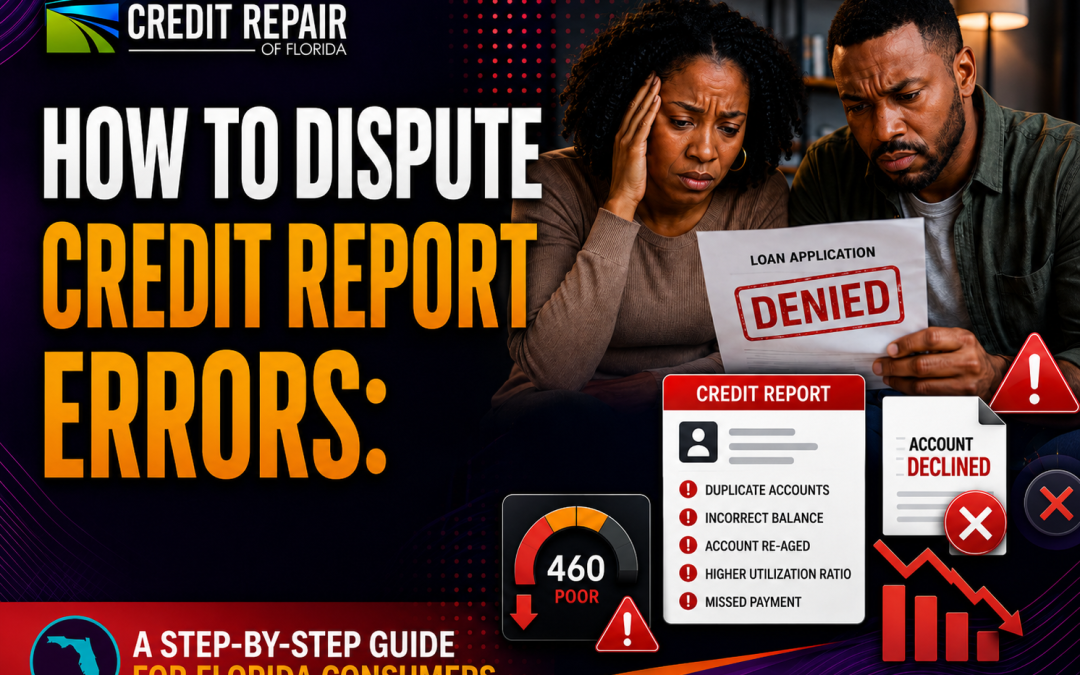
Credit report errors can lead to serious financial issues like loan denials and higher interest rates.
Consumers in Florida have the right to dispute inaccuracies, incomplete information, and outdated data on their credit reports.
Common credit report errors include incorrect personal information, accounts that do not belong to you, and outdated negative information.
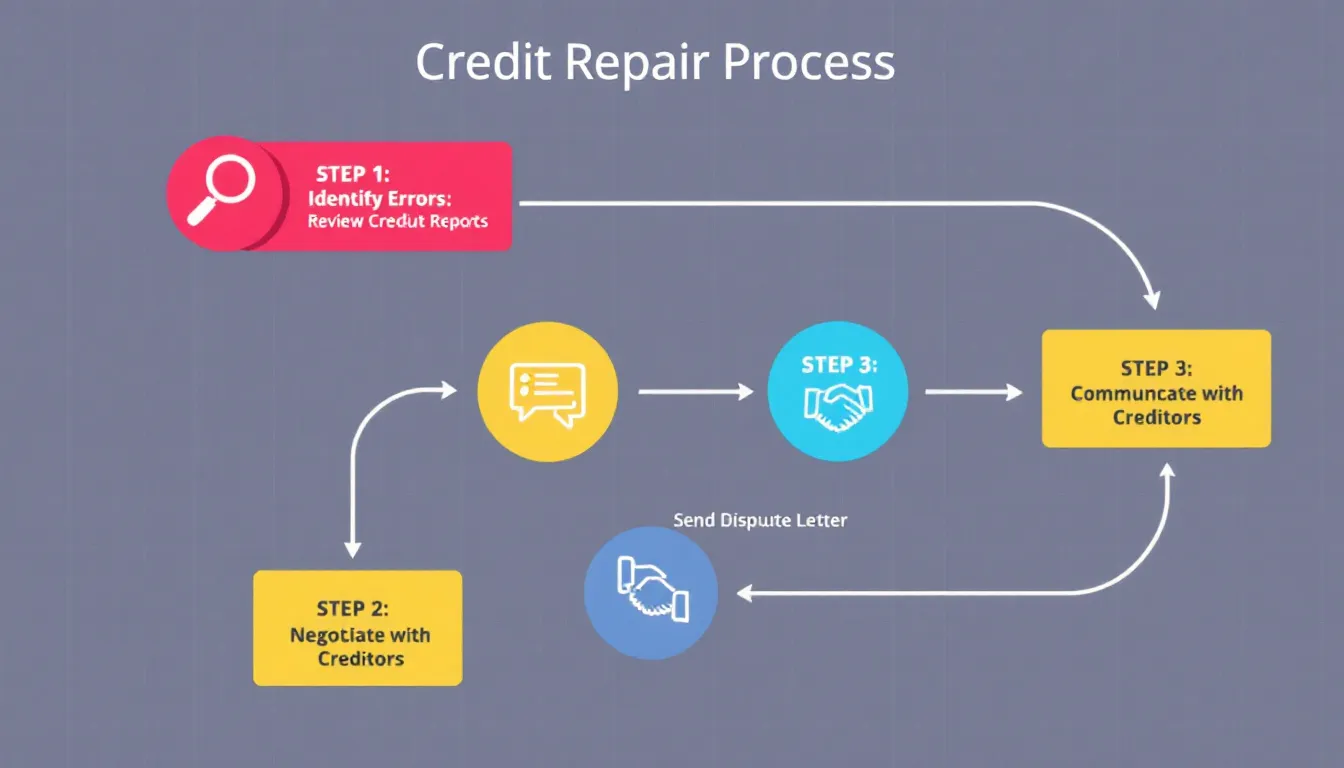
To dispute errors, gather supporting documents, submit clear dispute letters, and follow up on the investigation results.
Credit Repair of Florida assists consumers in reviewing credit reports and navigating the dispute process for Credit Report Errors.
Credit report errors can create serious problems for consumers in Florida. An inaccurate late payment, a collection account that does not belong to you, a wrong balance, or outdated negative information may affect your ability to qualify for credit cards, auto loans, mortgages, apartments, and other financial opportunities.
Many people do not realize how much information appears on their credit reports until they apply for financing and receive an unexpected denial, higher interest rate, or request for additional documentation. By that point, the mistake may already be causing stress.
The good news is that consumers have rights. Under federal law, you can dispute inaccurate, incomplete, outdated, duplicate, or unverifiable information on your credit reports. The credit bureaus and companies that report information must investigate valid disputes and correct or remove information that cannot be verified.
However, the dispute process is not always simple. You need to know what to look for, how to document the issue, where to send your dispute, and what to do if the problem remains.
This guide explains how to dispute credit report errors, what types of mistakes to watch for, how long the process may take, and when Florida consumers may benefit from professional credit report review assistance.
Why Credit Report Accuracy Matters
Your credit report is more than a list of accounts. It is a financial record that lenders, credit card companies, landlords, insurers, and sometimes employers may review when making decisions.
Credit reports may include personal identifying information, open and closed accounts, payment history, balances, credit limits, collections, inquiries, and certain public records such as bankruptcy. Credit scoring models use information from your credit reports to calculate credit scores.
When the information is accurate, your credit report gives lenders a clearer picture of your financial history. When the information is wrong, it may create an unfair picture of your creditworthiness.
For example, an incorrect late payment may make it look like you missed a payment when you paid on time. A collection account that belongs to someone else may make your report appear riskier than it really is. A balance that was already paid down may affect your credit utilization. Even a wrong address or unfamiliar account could be a warning sign of identity theft or mixed credit file issues.
That is why reviewing your credit reports regularly is important. You cannot fix errors you do not know exist.
Common Credit Report Errors to Look For
Credit report errors can appear in many different ways. Some mistakes are simple clerical issues. Others may be more serious and could suggest fraud, identity theft, or a mixed file.
Here are common credit report errors Florida consumers should watch for:
Incorrect Personal Information
Your credit report may show a wrong name spelling, outdated address, incorrect date of birth, or Social Security number variation. Personal information errors may not directly determine your credit score, but they can create confusion. They may also be connected to accounts that do not belong to you.
Accounts That Do Not Belong to You
An account that you never opened should be reviewed carefully. It may belong to another person with a similar name, or it may be connected to identity theft. Do not ignore unfamiliar accounts, especially if they show balances, late payments, or collection activity.
Incorrect Late Payments
Payment history is one of the most important areas of a credit report. If a creditor reports that you paid 30, 60, 90, or more days late, but you paid on time, you should gather proof and dispute the error.
Wrong Balances or Credit Limits
Credit card balances and credit limits can affect credit utilization. If your report shows a much higher balance than what you owe, or if the credit limit is reported incorrectly, your credit profile may look worse than it should.
Duplicate Accounts
Sometimes the same debt appears more than once, especially when an account has been sold, transferred, or sent to collections. Duplicate reporting can make your debt appear larger or more recent than it really is.
Outdated Negative Information
Most negative credit information cannot stay on your credit report forever. If an old collection, charge-off, or late payment remains beyond the allowed reporting period, it may be outdated and worth disputing.
Incorrect Account Status
An account may appear open when it was closed, active when it was paid, or past due when it is current. These status errors can affect how lenders view your credit history.
Collection Account Errors
Collection accounts often create confusion. The balance may be wrong, the original creditor may not be clear, the same debt may appear multiple times, or the collection may not belong to you. Collection errors should be reviewed carefully before you submit a dispute.
Bankruptcy Reporting Errors
Bankruptcy is generally the only public record that may appear on standard credit reports from the three major credit bureaus. If bankruptcy information appears incorrectly, uses the wrong filing date, lists accounts incorrectly, or remains longer than allowed, you may need to dispute the information.
Step 1: Get Your Credit Reports From All Three Credit Bureaus
The first step is to get your credit reports from Equifax, Experian, and TransUnion.
Do not review only one report. Creditors do not always report to all three bureaus. An error may appear on one report, two reports, or all three. You need to compare each report separately.
The official source for free credit reports is AnnualCreditReport.com. Consumers can access free weekly online credit reports from the three major credit bureaus. This makes it easier to monitor your reports throughout the year instead of waiting until a problem appears during a loan application.
When reviewing your reports, download or save copies for your records. If you later dispute an item, you may need to compare the original report with the updated version after the investigation.
Step 2: Review Each Section Carefully
Once you have your reports, review them slowly. Do not only check your score. A credit score is not the same thing as a credit report. Your score is calculated from the information in your report, so the report details matter.
Start with your personal information. Check your name, addresses, date of birth, employer information if listed, and any unfamiliar details.
Next, review each account. Look at the creditor name, account number, balance, payment history, date opened, date closed, account status, and any remarks. Compare the information with your own records.
Then review collection accounts. Look for unfamiliar collectors, duplicate debts, incorrect balances, or accounts that should no longer appear.
Finally, check credit inquiries. Hard inquiries usually appear when you apply for credit. If you see inquiries you do not recognize, they may need further review.
Take notes as you go. Write down the bureau reporting the issue, the account name, the account number shown on the report, and the specific problem.
Step 3: Identify Whether the Information Is Actually Inaccurate
Before disputing, make sure you understand what you are challenging.
Credit repair is not about removing accurate and timely negative information simply because it hurts your credit score. Accurate late payments, charge-offs, collections, bankruptcies, and other negative items may remain on your credit report for the time allowed by law.
A valid dispute focuses on information that is inaccurate, incomplete, outdated, duplicate, mixed with someone else’s information, the result of identity theft, or not verifiable.
For example, “this account is hurting my score” is not a strong dispute reason. A better dispute reason would be, “This account is reporting a 30-day late payment for March 2025, but my bank statement and creditor confirmation show the payment was made on time.”
The more specific your dispute, the easier it is for the credit bureau or furnisher to understand the issue.
Step 4: Gather Supporting Documents
Strong documentation can make your dispute clearer. You do not need to send every financial document you have, but you should include proof that directly supports your claim.
Helpful documents may include:
Bank statements showing payment dates
Canceled checks
Payment confirmation emails
Creditor letters
Account statements
Settlement letters
Paid-in-full letters
Identity theft reports
Police reports, when applicable
Court documents
Bankruptcy discharge documents
Letters showing an account was closed
Proof of address or identity, when needed
Keep copies of everything you send. If you mail a dispute, consider using certified mail so you have proof of delivery. If you submit a dispute online, save screenshots, confirmation numbers, and uploaded document records.
Step 5: Decide Who Should Receive the Dispute
You can dispute credit report errors with the credit bureau reporting the information. You may also dispute directly with the company that furnished the information. A furnisher may be a credit card company, bank, lender, debt collector, loan servicer, or other business that reports account information to the bureaus.
In many cases, it may make sense to contact both the credit bureau and the furnisher. The credit bureau investigates the dispute and communicates with the furnisher. The furnisher also has duties to investigate information it reports.
For example, if Experian shows an incorrect late payment from a credit card company, you may dispute the error with Experian and also contact the credit card company directly with your proof.
Be clear, organized, and factual. Avoid emotional language or vague explanations. A dispute should explain what is wrong, why it is wrong, and what correction you are requesting.
Step 6: Write a Clear Credit Report Dispute Letter
A dispute letter does not need to be complicated. It should identify you, identify the disputed item, explain the problem, and request correction or removal if the information cannot be verified.
Your dispute letter should include:
Your full name
Your current address
Your date of birth, if needed for identification
The last four digits of your Social Security number, if needed
The name of the credit bureau or furnisher
The account name and partial account number
A clear explanation of the error
A list of supporting documents
Your requested correction
Your signature and date
Here is an example:
“Dear [Credit Bureau Name],
I am writing to dispute inaccurate information on my credit report. The account listed as [Account Name] with account number ending in [XXXX] is reporting a 30-day late payment for [Month/Year]. This information is inaccurate because my payment was made on time. I have included documentation showing the payment confirmation and bank transaction.
Please investigate this item and correct the reporting. If the information cannot be verified as accurate, please remove or update it as required.
Sincerely, [Your Name]”
Do not use the same generic dispute language for every account. Tailor the dispute to the actual issue.
Step 7: Submit the Dispute
You can usually submit disputes online, by mail, or by phone. Each option has pros and cons.
Online disputes may be faster and convenient. However, some consumers prefer mail because it allows them to send a detailed letter, include copies of supporting documents, and keep a paper trail.
Phone disputes may work for simple issues, but they may not be ideal for complex disputes involving documents.
If the issue is serious, detailed, or connected to identity theft, written documentation may help you stay organized.
No matter how you submit the dispute, keep records. Save copies of letters, upload confirmations, tracking numbers, emails, screenshots, and responses.
Step 8: Wait for the Investigation Results
After a dispute is received, the credit bureau or furnisher generally must investigate and respond within the required timeframe. Many disputes are completed within about 30 days, although some situations may take longer depending on the type of dispute and whether additional information is submitted.
During the investigation, the bureau may contact the furnisher to verify the information. The furnisher may confirm, correct, update, or delete the information.
When the investigation ends, you should receive results explaining what happened. The item may be corrected, deleted, updated, or verified as accurate.
Read the results carefully. Do not assume the issue was fixed just because you received a response.
Step 9: Review Your Updated Credit Report
After the investigation, review your updated credit report. Confirm whether the bureau made the correction you requested.
After the investigation, confirm that the credit bureau made the requested change. Deleted items should no longer appear on your report. Updated items should reflect the new, accurate information. When an item is verified as accurate, review the explanation carefully and compare it with your documents.
Sometimes a dispute fixes one issue but leaves another problem behind. For example, a balance may be corrected, but the account status may still be wrong. You may need to follow up with a more specific dispute.
What If the Credit Report Error Is Not Fixed?
If the error remains, do not give up automatically. You may still have options.
First, review the dispute response. Review the dispute response carefully. The bureau may say the item was verified, state that your dispute lacked enough information, or label the dispute as frivolous or irrelevant. Understanding the reason can help you decide what to do next. Understanding the reason can help you decide what to do next.
Second, gather stronger documentation. If your first dispute was vague, your next dispute should be more specific. Include proof that directly supports your position.
Third, consider disputing with the furnisher if you only disputed with the credit bureau. The company reporting the information may need to review its own records.
Fourth, consider filing a complaint with the Consumer Financial Protection Bureau if you believe the bureau or furnisher failed to properly investigate your dispute.
You may also add a consumer statement to your credit report. This statement lets you explain your side of the issue. However, a consumer statement does not remove the disputed information or guarantee that lenders will view the account differently.
Credit Report Errors and Identity Theft
Some credit report errors are signs of identity theft. If you see accounts, addresses, inquiries, or collections you do not recognize, take the issue seriously.
Identity theft can happen when someone uses your personal information to open accounts, apply for credit, or create debt in your name. The sooner you act, the easier it may be to limit the damage.
If you suspect identity theft, consider taking these steps:
Review all three credit reports
Place a fraud alert or credit freeze
Contact the creditor or collector connected to the account
Report identity theft at IdentityTheft.gov
File a police report if needed
Dispute fraudulent accounts with the credit bureaus
Keep copies of all reports and letters
A credit freeze can help prevent new accounts from being opened in your name. A fraud alert tells creditors to take extra steps to verify your identity before opening new credit.
Mistakes to Avoid When Disputing Credit Report Errors
Disputing credit report errors can help protect your credit, but mistakes can slow the process or weaken your claim.
Avoid these common errors:
Disputing Everything at Once Without a Reason
Some consumers dispute every negative item on their credit report hoping something will be removed. This can create problems. Disputes should focus on specific information that is inaccurate, incomplete, outdated, duplicate, or unverifiable.
Using Vague Language
A vague dispute such as “this is wrong” does not explain the issue. Be specific. Identify the account, the reporting error, the date, and the correction you want.
Failing to Include Proof
Not every dispute requires extensive documentation, but proof can help. If you have payment confirmations, letters, or account records, include copies.
Ignoring the Furnisher
The credit bureau is important, but the company reporting the information matters too. If the furnisher keeps reporting the same error, the issue may continue.
Not Keeping Records
Always keep copies of disputes, documents, tracking numbers, and investigation results. If the error returns or the dispute is not resolved, your records may help.
Expecting Accurate Information to Disappear
Credit disputes are designed to correct inaccurate or unverifiable information. They are not a shortcut to erase accurate and timely negative information.
Should You Dispute Credit Report Errors Yourself?
Yes, you can dispute credit report errors yourself. Federal law gives consumers the right to dispute inaccurate information without hiring anyone.
However, some consumers feel overwhelmed by the process. Others may have multiple errors, old accounts, collection issues, identity theft concerns, or previous disputes that did not resolve the problem.
Professional credit report review assistance may be helpful if you do not know where to start, have trouble organizing documents, or want guidance on identifying possible inaccuracies.
A reputable credit repair company should not promise guaranteed deletions, overnight score increases, or removal of accurate negative information. Instead, it should help you understand your credit reports, identify questionable information, and assist with a lawful dispute process.
How Credit Repair of Florida Helps Consumers
At Credit Repair of Florida, we help consumers review their credit reports and identify information that may be inaccurate, incomplete, outdated, duplicate, or unverifiable.
Our process is designed to help Florida consumers better understand what appears on their credit reports and what options may be available. We do not promise that accurate information will be removed. We also do not create false identities, encourage misleading disputes, or guarantee a specific credit score increase.
Instead, we focus on education, review, organization, and dispute assistance based on the information in your credit reports.
If you live in Florida and believe your credit report contains errors, our team can help you take the next step with a more informed approach.
When to Review Your Credit Reports
You should review your credit reports regularly, but certain life events make it especially important.
Check your reports before applying for a mortgage, auto loan, apartment, business financing, or major credit card. You should also review your reports after identity theft, after paying or settling an account, after bankruptcy, after a divorce, or when you receive a credit denial.
Florida consumers planning to buy a home, refinance, purchase a car, or rebuild credit after financial hardship should pay close attention to report accuracy. A single error can create unnecessary obstacles.
Regular review gives you time to find and dispute errors before they interfere with important financial decisions.
Final Thoughts: You Have the Right to an Accurate Credit Report
Credit report errors are frustrating, but you do not have to ignore them. If information on your credit report is inaccurate, incomplete, outdated, duplicate, or unverifiable, you have the right to dispute it.
Start by getting your reports from all three credit bureaus. Review every section carefully. Gather proof. Submit clear disputes. Track your results. If the error remains, follow up with stronger documentation or additional action.
The key is to stay organized and focus on facts.
If you are unsure what to dispute or how to begin, Credit Repair of Florida can help you review your credit reports and understand your options.
Your credit report should tell an accurate story. If it does not, taking action may help you protect your financial future.
FAQ Section
How do I dispute credit report errors?
You can dispute credit report errors by contacting the credit bureau reporting the information. You may also dispute directly with the company that furnished the information, such as a lender, credit card company, debt collector, or loan servicer. Your dispute should clearly explain what is wrong and include supporting documents when available.
How long does a credit report dispute take?
Many credit report disputes are investigated within about 30 days after they are received. Some situations may take longer, especially if more information is needed. After the investigation, you should receive results explaining whether the item was corrected, deleted, updated, or verified as accurate.
Can I dispute credit report errors online?
Yes. Equifax, Experian, and TransUnion allow consumers to dispute credit report errors online. You may also dispute by mail or phone. For detailed disputes with supporting documents, some consumers prefer mail because it creates a stronger paper trail.
What documents do I need to dispute a credit report error?
Helpful documents may include bank statements, payment confirmations, account letters, settlement agreements, identity theft reports, court records, bankruptcy documents, or correspondence from creditors. The best documents are the ones that directly prove why the reported information is wrong.
Can accurate negative information be removed from my credit report?
Accurate and timely negative information generally cannot be removed simply because it hurts your credit score. Credit disputes are meant to correct or remove information that is inaccurate, incomplete, outdated, duplicate, fraudulent, or unverifiable.
What should I do if a credit report error comes back?
If an error returns, review your dispute results, gather stronger documentation, and consider disputing with both the credit bureau and the furnisher. If you believe your dispute was not handled properly, you may also consider filing a complaint with the Consumer Financial Protection Bureau.
Can credit report errors affect my ability to get approved?
Yes. Credit report errors may affect loan approvals, credit card applications, apartment applications, interest rates, and other financial decisions. That is why it is important to review your reports before major credit applications.
Does Credit Repair of Florida help with credit report disputes?
Yes. Credit Repair of Florida helps consumers review their credit reports and identify information that may be inaccurate, incomplete, outdated, duplicate, or unverifiable. Our team can help you understand your options and assist with the dispute process.
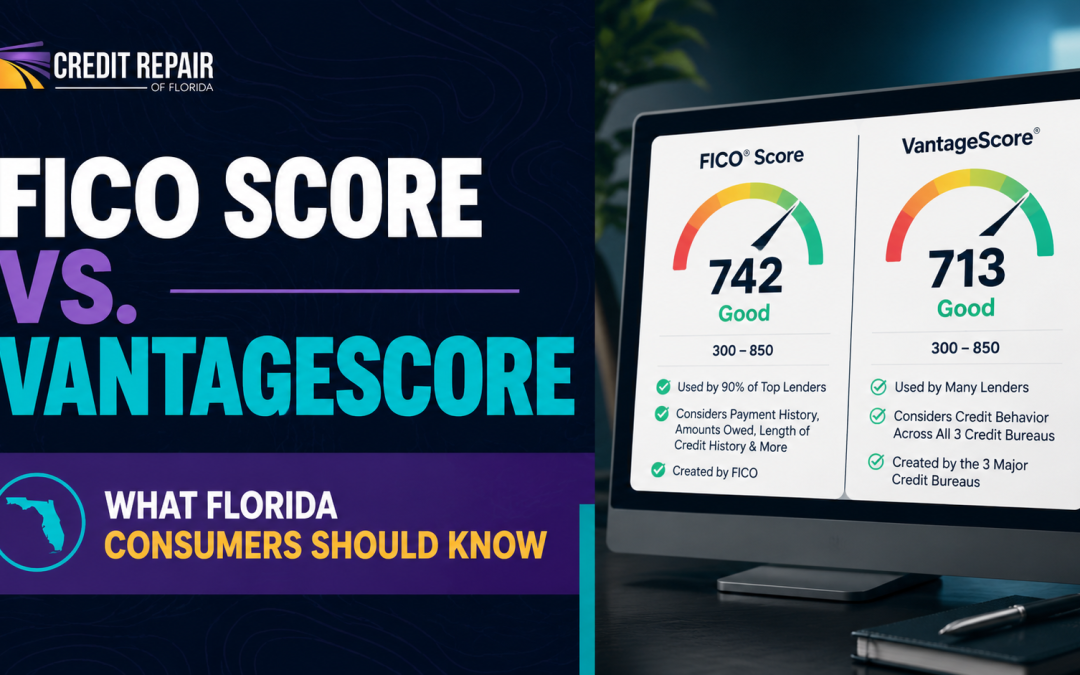
FICO Scores are widely used by lenders, especially in traditional lending decisions.
VantageScore is also used in the marketplace and is commonly shown by free credit monitoring tools.
Your FICO Score and VantageScore may be different, even if they are based on information from the same credit bureau.
A lender may use a different scoring model than the one you see through a free app.
Newer scoring models, including FICO 10T and VantageScore 4.0, are increasingly important because they can consider credit behavior patterns over time.
The best way to support both types of scores is to focus on accurate credit reporting, on-time payments, lower credit card balances, responsible account management, and regular credit report reviews.
When people talk about credit scores, they often assume everyone has one single number that all lenders see. In reality, consumers can have multiple credit scores depending on the scoring model, credit bureau, and date the score is calculated. You may check your score through a free credit monitoring app and see one number, then apply for a mortgage, car loan, credit card, or apartment and discover that the lender is using a different score.
Two of the most common credit scoring models are FICO Score and VantageScore. Both are designed to help lenders evaluate credit risk, but they are not the same. They may use similar score ranges, but they can weigh credit report information differently.
Understanding the difference matters because lenders, credit card companies, mortgage companies, auto finance companies, landlords, insurers, and financial platforms may rely on different scoring models. A score you see online can be useful for monitoring your credit health, but it may not be the exact score used in a lending decision.
For Florida consumers, this is especially important when preparing to buy a home, finance a vehicle, refinance debt, rent an apartment, or review credit report errors. Your credit score may affect approval decisions, interest rates, loan terms, deposits, and other financial opportunities.
This guide explains the key differences between FICO Score and VantageScore, why your scores may not match, which scores lenders may use, and how to build stronger credit over time.
What Is a Credit Score?
A credit score is a three-digit number calculated from information in your credit reports. It is designed to help lenders estimate how likely you may be to repay borrowed money as agreed.
Credit scores are not random numbers. They are based on credit report data, such as:
Your payment history
Your credit card balances
Your credit limits
Your account ages
Your mix of credit accounts
Recent credit applications
Collections, charge-offs, or other negative items
Public record information that may appear on your credit file
Because credit scores are based on credit report information, the accuracy of your credit reports matters. If your reports contain inaccurate, outdated, incomplete, duplicated, or unverifiable information, your scores may be affected.
In the United States, the three major credit bureaus are Equifax, Experian, and TransUnion. These companies collect and maintain credit information reported by lenders, creditors, debt collectors, and other data furnishers. FICO and VantageScore use information from credit reports to calculate scores, but they do so using different scoring formulas.
This is one reason you may have more than one credit score. You do not have just one score. You may have many credit scores depending on the scoring model, the credit bureau data used, the scoring version, and the date the score was calculated.
What Is a FICO Score?
A FICO Score is a credit score created by the Fair Isaac Corporation, commonly known as FICO. FICO is one of the most recognized names in credit scoring and has been used in lending for decades.
Many lenders use FICO Scores when evaluating applications for credit cards, auto loans, personal loans, mortgages, and other financial products. However, there is not only one FICO Score. There are different FICO scoring versions, and lenders may use different versions depending on the type of credit being requested.
For example, a credit card issuer may use one FICO model, while a mortgage lender may use a different FICO model. An auto lender may use an industry-specific FICO Auto Score. This means the score you see from one source may not be the exact same score a lender sees.
FICO Scores commonly range from 300 to 850. A higher score generally suggests lower credit risk, while a lower score may suggest higher credit risk. However, each lender sets its own approval standards. A score that qualifies you with one lender may not qualify you with another.
FICO scoring models generally consider five broad categories:
Payment history
Amounts owed
Length of credit history
Credit mix
New credit
Payment history and amounts owed are especially influential. This is why late payments, high credit card balances, collections, charge-offs, and other negative information can have a meaningful impact on your score.
What Is VantageScore?
VantageScore is another credit scoring model. It was created through a joint effort by the three major credit bureaus: Equifax, Experian, and TransUnion.
Like FICO, VantageScore is designed to help lenders evaluate credit risk. VantageScore models also commonly use a 300 to 850 range. However, VantageScore does not use the exact same formula as FICO.
Many consumers first encounter VantageScore through free credit monitoring apps, banking dashboards, credit card portals, and financial education tools. That can be helpful because it gives consumers a way to monitor general credit health. However, it can also create confusion when the score shown in an app does not match the score used by a lender.
VantageScore has released multiple versions, including VantageScore 3.0 and VantageScore 4.0. VantageScore 4.0 is especially important because it uses trended credit data, which can look at patterns in a consumer’s credit behavior over time.
For example, trended data may help show whether a consumer is paying balances down, keeping balances stable, or steadily increasing debt. This can provide a different view than a single snapshot of credit information on one date.
FICO Score vs. VantageScore: Quick Comparison
Here is a simple comparison:
Category
FICO Score
VantageScore
Common score range
300 to 850
300 to 850
Created by
Fair Isaac Corporation
Developed by Equifax, Experian, and TransUnion
Common use
Widely used by lenders
Used by lenders and many credit monitoring platforms
Scoring versions
Multiple versions, including FICO 8, FICO 9, FICO 10, FICO 10T, and industry-specific models
Multiple versions, including VantageScore 3.0 and VantageScore 4.0
Credit history requirements
May require more established credit history, depending on the model
May score some consumers with thinner credit files
Data used
Credit report data
Credit report data
Model differences
Weighs credit factors using FICO formulas
Weighs credit factors using VantageScore formulas
Mortgage relevance
FICO has historically played a major role in mortgage lending
VantageScore 4.0 is becoming more relevant in mortgage credit score modernization
Both scoring models are important. However, they are not interchangeable. A 700 FICO Score and a 700 VantageScore may not mean the exact same thing to every lender because they are calculated differently.
Why Your FICO Score and VantageScore May Be Different
It is common for consumers to see different credit scores from different sources. This does not automatically mean something is wrong. Several factors can explain the difference.
1. The scoring formulas are different
FICO and VantageScore use different mathematical models. They may consider many of the same types of credit report information, but they may weigh that information differently.
For example, both models care about payment history and credit utilization, but the exact impact of a late payment or high balance may not be identical.
2. The score may be based on different credit bureau data
Your Equifax, Experian, and TransUnion credit reports may not be identical. One lender may report to all three bureaus, while another may report to only one or two. A collection account may appear on one report but not another. A balance update may show on one bureau before it appears on the others.
Because of these differences, a score based on Experian data may differ from a score based on TransUnion or Equifax data.
3. The scoring version may be different
There are many versions of FICO and VantageScore. For example, FICO 8, FICO 9, FICO 10, FICO 10T, VantageScore 3.0, and VantageScore 4.0 are not all the same.
A lender may use one version, while a monitoring app may show another. This can lead to different scores.
4. The score may have been calculated on a different date
Credit scores can change when new information is reported. If your credit card issuer reports a higher balance this month, your score may change. If a payment posts, an account ages, or an inquiry becomes older, your score may also change.
Even a difference of a few days can matter if your credit reports changed during that time.
5. Not every lender uses the score you see online
Free credit score tools can be useful for tracking general trends, but they may not show the exact score a lender uses. Before applying for major financing, such as a mortgage or auto loan, it is helpful to understand that your application may be evaluated using a different scoring model.
Which Credit Score Do Lenders Use?
Many lenders use FICO Scores, but the exact score model depends on the lender, the credit product, and the lender’s underwriting process. A mortgage lender may use one scoring model, while a credit card issuer or auto finance company may use another.
VantageScore is also used in the marketplace, and its role has grown over time. Some lenders, fintech companies, and financial platforms may use VantageScore for certain decisions, risk evaluations, or account management purposes.
For consumers, the practical lesson is simple: do not assume the score you see in one app is the score every lender will use.
A free credit score can still be valuable. It can help you monitor trends, spot sudden changes, and understand whether your credit profile is generally improving or declining. However, when you are preparing for a major loan, it is wise to review your full credit reports and ask the lender what type of score or credit criteria they use.
What Are FICO 10T and VantageScore 4.0?
FICO 10T and VantageScore 4.0 are newer scoring models that have received more attention because of changes in mortgage credit score modernization.
The “T” in FICO 10T refers to trended data. Trended data looks at patterns in credit behavior over time instead of only looking at a single moment. VantageScore 4.0 also uses trended credit data.
This matters because two consumers may have similar balances on the same day, but very different credit behavior patterns. One person may be steadily paying debt down, while another may be increasing balances month after month. Trended data can help scoring models evaluate those patterns.
For Florida consumers preparing to buy a home, this is important because mortgage lending standards and credit score model usage continue to evolve. Even when these changes do not affect every borrower immediately, they show why long-term credit habits matter.
Instead of focusing only on a quick score boost before applying, consumers should focus on building consistent positive patterns:
Paying on time every month
Reducing revolving balances
Avoiding unnecessary new debt
Keeping accounts in good standing
Reviewing credit reports for accuracy
Addressing credit report errors early
In newer scoring models, your recent and ongoing credit behavior may matter even more because trends can tell a story.
Why Credit Reports Matter More Than Any Single Score
Many consumers focus heavily on the score number. That is understandable. Scores are easy to compare, and lenders often use them as part of a decision.
However, your credit reports are the foundation. Your scores are calculated from the information in your credit reports. If the underlying report data is wrong, your score may not accurately reflect your credit history.
That is why it is important to review all three major credit reports, not just one score.
Common credit report problems may include:
Accounts that do not belong to you
Duplicate collection accounts
Incorrect account balances
Wrong payment history
Accounts listed as open when they were closed
Outdated negative information
Incorrect personal information
Mixed credit files
Debts that were already paid or settled but still report inaccurately
Collection accounts with missing or questionable details
Information that cannot be verified
If you find inaccurate, incomplete, outdated, or unverifiable information, you have the right to dispute it with the credit bureaus. Credit repair may help consumers identify and address these types of reporting issues.
FICO Score Factors Explained
Although FICO has different scoring versions, FICO Scores generally evaluate several major credit categories. Understanding these categories can help you make smarter credit decisions.
Payment history
Payment history is one of the most important credit scoring factors. Lenders want to know whether you have paid past accounts on time.
Late payments, charge-offs, collections, repossessions, foreclosures, and other serious negative items may hurt your score. The impact can depend on the severity, frequency, recency, and overall credit profile.
A single late payment may affect one person differently than another, depending on the rest of the credit file. However, consistently paying on time is one of the strongest habits for long-term credit health.
Amounts owed
Amounts owed often refers to how much debt you carry, especially compared to your available credit limits. Credit card utilization is a major part of this category.
For example, if you have a credit card with a $1,000 limit and a $900 balance, your utilization on that card is 90%. High utilization can make you appear more financially stretched.
Lower utilization is generally better for credit scores. Many consumers focus on keeping balances below 30% of available credit, but lower may be better depending on the scoring model and credit profile.
Length of credit history
Scoring models may consider how long your accounts have been open. Older accounts can help show a longer track record of credit management.
This is why closing old positive accounts can sometimes affect your credit profile. It may reduce available credit and eventually affect the age of accounts considered in scoring.
Credit mix
Credit mix refers to the variety of accounts on your credit reports. For example, a credit profile may include credit cards, auto loans, student loans, mortgages, or personal loans.
You do not need every type of account to have good credit. However, responsibly managing different types of credit can support a stronger profile.
New credit
Applying for new credit can create hard inquiries. Too many hard inquiries in a short period may affect your score and may signal increased risk to lenders.
Opening several new accounts quickly can also lower your average account age. This does not mean you should avoid new credit forever, but it does mean you should apply strategically.
VantageScore Factors Explained
This scoring model also considers credit report information, but it organizes and weights the factors differently.
Common VantageScore factors include:
Payment history
Depth of credit
Credit utilization
Balances
Recent credit
Available credit
Payment history is highly important. Credit utilization and balances can also have a significant impact. Like FICO, VantageScore generally rewards responsible credit use and penalizes signs of higher risk, such as missed payments or excessive revolving debt.
One important feature of VantageScore 4.0 is its use of trended credit data. This can help evaluate patterns in how consumers manage balances and payments over time.
For example, if your balance is high today but you have been consistently paying it down, that trend may tell a different story than a high balance that keeps increasing.
Why Free Credit Scores May Not Match Lender Scores
Many people become frustrated when a free app shows one score and a lender gives them another. This is one of the most common credit score misunderstandings.
Free scores are not useless. They can be very helpful for monitoring general credit direction. If your score drops suddenly, it may alert you to a new balance, missed payment, inquiry, collection, or possible reporting error.
However, free scores may differ from lender scores because:
The app may show VantageScore while the lender uses FICO.
The app may use TransUnion data while the lender uses Experian or Equifax.
The score may be updated weekly while the lender pulls a fresh score today.
The lender may use an industry-specific score.
The lender may use a different scoring version.
The lender may consider other factors beyond the score.
This is why consumers should treat free scores as educational tools, not as guaranteed lender approval numbers.
FICO vs. VantageScore for Mortgages
Mortgage lending has historically relied heavily on FICO scoring models. However, the mortgage industry has been moving toward updated scoring models, including FICO 10T and VantageScore 4.0.
This shift is important because newer models may evaluate credit data differently than older models. In particular, trended data may play a greater role.
For homebuyers, the lesson is not to panic or chase a specific score model. Instead, focus on the credit behaviors that generally help across scoring models:
Pay every account on time.
Lower credit card balances.
Avoid opening unnecessary accounts before applying.
Do not make large credit changes without speaking to your mortgage professional.
Review all three credit reports well before applying.
Address possible reporting errors early.
If you are planning to buy a home in Florida, it is smart to begin reviewing your credit months in advance. Waiting until a few weeks before applying may not leave enough time to correct errors or improve financial habits.
FICO vs. VantageScore for Auto Loans
Auto lenders may use FICO Scores, VantageScore, or industry-specific scoring models. Some auto lenders use FICO Auto Scores, which are designed specifically for vehicle financing decisions.
This means the score you see online may not be the same score used at a dealership or credit union.
If you are preparing to finance a car, pay attention to your credit reports, not just the score. Auto lenders may review your payment history, current debts, income, down payment, loan amount, and prior auto loan history.
Before applying, it may help to:
Review your credit reports
Pay down revolving balances if possible
Avoid unnecessary new credit
Compare financing options
Understand the difference between prequalification and final approval
Ask lenders whether they use a soft pull or hard pull
FICO vs. VantageScore for Credit Cards
Credit card issuers may use different scoring models depending on their underwriting systems. Some may use FICO, some may use VantageScore, and some may use internal models combined with credit bureau data.
Credit card approval decisions often consider more than the score. Issuers may also look at income, existing debt, recent applications, prior relationship with the bank, and current credit limits.
Credit card balances can have a strong effect on both FICO and VantageScore. Because credit cards are revolving accounts, utilization can change month to month. Paying down high balances may help your credit profile, but the timing of when your card issuer reports the balance can matter.
For example, paying your balance after the statement closes may still result in a higher balance being reported. If you are preparing for a credit application, it may be useful to understand your statement closing dates and payment due dates.
Which Score Should Florida Consumers Pay Attention To?
Florida consumers should pay attention to both FICO Score and VantageScore, but they should not obsess over one number.
The better approach is to monitor:
Your credit reports from Equifax, Experian, and TransUnion
Your payment history
Your credit card utilization
Your account balances
New inquiries
Collections or charge-offs
Identity theft warning signs
Incorrect or unfamiliar accounts
Your score is the result of the information in your reports. If your reports improve, your scores may improve over time depending on the scoring model. If your reports contain negative or inaccurate information, your scores may be affected.
This is especially important for consumers who are rebuilding after financial hardship, debt settlement, bankruptcy, divorce, medical debt, identity theft, job loss, or collection activity.
How Credit Report Errors Can Affect FICO and VantageScore
Credit report errors can affect more than one scoring model. Since both FICO and VantageScore rely on credit report data, inaccurate information may influence multiple scores.
For example, if a collection account appears on your report but does not belong to you, that account could affect both FICO and VantageScore calculations. If a credit card reports the wrong balance or limit, your utilization may appear higher than it really is.
Common errors that may affect scores include:
Incorrect late payments
Duplicate debts
Accounts from identity theft
Wrong account status
Incorrect charge-off dates
Paid accounts still showing unpaid
Settled accounts reporting inaccurately
Old debts reappearing with incorrect dates
Mixed files with another person’s information
Incorrect collection agency reporting
These issues can be frustrating, especially if you are preparing for financing. Credit repair focuses on reviewing credit reports and challenging information that may be inaccurate, incomplete, outdated, or unverifiable.
How to Improve Both FICO Score and VantageScore
While FICO and VantageScore are different, many responsible credit habits can help support both.
Pay every bill on time
On-time payment history is one of the strongest credit habits. Even one missed payment can hurt, especially if it becomes 30 days late or more.
Set reminders, use autopay when appropriate, and contact creditors early if you are experiencing hardship.
Keep credit card balances low
Credit utilization can strongly affect credit scores. If possible, keep balances low compared to limits.
This does not mean you need to carry a balance. In fact, carrying a balance can cost interest. Paying in full may help you avoid interest charges while supporting responsible credit use.
Avoid applying for too much new credit at once
Multiple applications in a short time can create hard inquiries and may lower the average age of your accounts. Apply for credit strategically.
If you are shopping for a mortgage or auto loan, ask lenders how rate shopping inquiries may be handled.
Keep older positive accounts open when possible
Older accounts can help your credit profile. If an older account has no annual fee and is in good standing, keeping it open may help preserve available credit and account age.
However, this depends on your personal financial situation. If a card has high fees or creates overspending risk, closing it may still make sense.
Review all three credit reports
Do not rely only on one score or one bureau. Review Equifax, Experian, and TransUnion.
Look for unfamiliar accounts, inaccurate balances, outdated negative items, and duplicate collections.
Dispute inaccurate information
If you find information that is inaccurate, incomplete, outdated, or unverifiable, you may dispute it with the credit bureaus.
When disputing, include clear explanations and supporting documentation when available.
Avoid illegal credit repair tactics
Be cautious of anyone promising a “new credit identity,” guaranteed score increases, instant deletions, or methods involving false identity information. These tactics can be illegal and harmful.
Legitimate credit repair focuses on your rights, accurate reporting, and the dispute process.
What Credit Repair Can and Cannot Do
Credit repair can help consumers review their credit reports and challenge information that may be inaccurate, incomplete, outdated, or unverifiable.
Credit repair may help when your credit reports contain:
Incorrect late payments
Accounts that are not yours
Duplicate collections
Outdated negative accounts
Unverifiable account information
Mixed-file information
Incorrect balances or statuses
Identity theft-related accounts
However, credit repair cannot legally guarantee a specific score increase. Credit repair cannot erase accurate and timely negative information simply because it is hurting your score. Creating a new legal credit identity is not something legitimate credit repair can do. Lender approval also cannot be forced or guaranteed.
A compliant credit repair process should be based on accuracy, documentation, consumer rights, and proper communication with credit bureaus, furnishers, and collection agencies.
At Credit Repair of Florida, the goal is to help consumers better understand their credit reports, identify questionable information, and take informed steps toward a more accurate credit profile.
Why Your Credit Score May Drop Even When You Are Doing the Right Things
Sometimes a credit score changes in ways that feel unfair. You may pay a bill, close an account, or reduce debt and still see a temporary drop.
Here are some common reasons:
A credit card balance increased before the statement closed.
An old account was closed and reduced your available credit.
A new hard inquiry appeared.
A new account lowered your average account age.
A collection was added.
A credit limit decreased.
A lender updated old account information.
Different scoring models reacted differently to the same change.
This is why it is important to look beyond the number and review what changed on your credit reports.
Why Scores Can Differ Between Equifax, Experian, and TransUnion
Even if the same scoring model is used, scores can differ across the three credit bureaus because the underlying credit reports may differ.
One bureau may show:
A different balance
A different credit limit
A missing account
An extra collection
A different inquiry
A different payment update date
An account that has not been updated yet
Because lenders are not always required to report to all three bureaus, differences are common. This is also why reviewing all three reports matters.
Should You Worry If Your VantageScore Is Higher Than Your FICO Score?
Not necessarily. It is common for one score to be higher than another.
A higher VantageScore does not automatically mean a lender will approve you. A lower FICO Score does not automatically mean your credit is terrible. Scores must be understood in context.
Instead of focusing only on the difference, ask:
Which credit bureau is each score based on?
Which scoring version is being used?
When was each score updated?
Did any account recently change?
Are there errors on one report but not another?
Which score does the lender actually use?
The most important step is to keep your reports accurate and your financial habits consistent.
Should You Worry If Your FICO Score Is Higher Than Your VantageScore?
Again, not necessarily. The models are different. One may respond more strongly to certain information than the other.
If your FICO Score is higher than your VantageScore, review your credit reports for the same issues:
High balances
Recent late payments
New inquiries
Collections
Account age
Credit limits
Incorrect reporting
The difference itself is not always a problem. The reason behind the difference is what matters.
How to Prepare Your Credit Before Applying for a Mortgage in Florida
If you plan to buy a home in Florida, begin preparing your credit early. Mortgage underwriting can be detailed, and credit score requirements may vary by loan type, lender, and borrower profile.
Here are steps to consider:
Review all three credit reports several months before applying.
Look for inaccurate, incomplete, outdated, or unverifiable information.
Avoid opening unnecessary new credit accounts.
Avoid large credit card balances.
Pay all accounts on time.
Do not co-sign new debt before applying.
Keep financial documents organized.
Speak with a licensed mortgage professional about loan requirements.
Avoid making major financial changes without guidance.
Credit preparation is not just about the score. Lenders may review your debt-to-income ratio, employment, income, assets, down payment, reserves, and credit history.
How to Prepare Your Credit Before Applying for an Auto Loan
Before applying for an auto loan, review your credit reports and understand your budget.
Dealership financing can involve multiple lender submissions, so ask questions before authorizing credit pulls. Compare offers from banks, credit unions, and online lenders when possible.
To prepare:
Check your reports for errors.
Pay down credit card balances if possible.
Avoid new unnecessary accounts.
Save for a down payment.
Know your realistic monthly payment.
Review total loan cost, not just the payment.
Be cautious with extended loan terms that may increase total interest.
A better credit profile may help you qualify for more favorable terms, but every lender has its own criteria.
How to Prepare Your Credit Before Applying for a Credit Card
Before applying for a credit card, check whether the issuer offers prequalification. Prequalification may use a soft inquiry, although final approval usually requires a hard inquiry.
Consider:
Your current credit score range
Recent inquiries
Current balances
Existing credit limits
Annual fees
Interest rates
Rewards programs
Whether the card fits your spending habits
Avoid applying for multiple cards just to see what happens. Too many applications may hurt your credit profile.
Common Myths About FICO and VantageScore
Myth 1: You only have one credit score
You have many possible credit scores. Scores vary by model, version, bureau, and date.
Myth 2: The score in my app is the score every lender sees
Not always. Many apps show educational scores or VantageScore models. Lenders may use different models.
Myth 3: Checking your own score hurts your credit
Checking your own credit is generally considered a soft inquiry and does not hurt your score.
Myth 4: Closing a credit card always helps
Closing a credit card can reduce available credit and may increase utilization. It may help in some situations, but it is not automatically good for your score.
Myth 5: Carrying a balance improves your credit
You do not need to carry a balance and pay interest to build credit. Responsible use and on-time payments matter.
Myth 6: Credit repair can guarantee a score increase
No legitimate credit repair company should guarantee a specific score increase. Results depend on your credit reports, the accuracy of the information, and how bureaus and furnishers respond.
FICO vs. VantageScore: Which One Is More Important?
There is no single answer for every consumer.
FICO may be more important if your lender uses FICO. VantageScore may be more relevant if a lender, platform, or monitoring tool uses VantageScore. For mortgage lending, changes involving FICO 10T and VantageScore 4.0 make it important to understand both.
Instead of choosing one score to care about, focus on what both models have in common:
They rely on credit report data.
They reward on-time payments.
They are affected by high revolving balances.
They may react to recent credit applications.
They may be hurt by serious negative information.
They depend on accurate reporting.
If you build a stronger, cleaner, more accurate credit profile, you are generally supporting both types of scores.
When to Get Help With Credit Report Issues
You may want help if:
You do not understand what is on your credit reports.
You see accounts you do not recognize.
You have duplicate collections.
You have old debts still reporting.
You believe an account is reporting inaccurately.
You were denied credit because of report information.
You are preparing for a mortgage or auto loan.
You experienced identity theft.
You are overwhelmed by the dispute process.
Credit repair is not magic, and it is not instant. However, professional support can help consumers understand their reports, organize disputes, and address questionable information more effectively.
Final Thoughts: Understanding the Difference Can Help You Make Better Credit Decisions
FICO Score and VantageScore are both important credit scoring models, but they are not the same. They may use similar score ranges, but they can calculate scores differently, rely on different versions, and be used by different lenders.
The score you see online can be helpful, but it may not be the exact score used for a mortgage, auto loan, credit card, or rental decision. That is why consumers should pay close attention to their full credit reports, not just one score.
For Florida consumers, the best strategy is to build strong credit habits over time, monitor all three credit reports, correct inaccurate information, and avoid risky shortcuts.
At Credit Repair of Florida, we help consumers review their credit reports and identify inaccurate, incomplete, outdated, or unverifiable information that may be affecting their credit. If you are unsure why your scores are different or you believe your credit reports contain errors, our team can help you understand your options and take the next step.
Frequently Asked Questions About FICO Score vs. VantageScore
Is FICO better than VantageScore?
Not necessarily. FICO and VantageScore are different credit scoring models. FICO Scores are widely used by lenders, while VantageScore is also used in the marketplace and commonly shown by free credit monitoring platforms. The most important score is the one your specific lender uses.
Why is my VantageScore different from my FICO Score?
Your scores may differ because FICO and VantageScore use different formulas. They may also be based on different credit bureau data, different scoring versions, or different update dates.
Why is my VantageScore higher than my FICO Score?
A VantageScore may be higher because the model weighs your credit information differently. It may also be based on a different credit bureau report or a more recent update. A higher VantageScore does not guarantee that a lender using FICO will see the same number.
Why is my FICO Score higher than my VantageScore?
Your FICO Score may be higher because of differences in scoring formulas, bureau data, account updates, or the specific scoring version being used. The difference is not always a sign of an error, but it is worth reviewing your credit reports for accuracy.
Do mortgage lenders use FICO or VantageScore?
Mortgage lenders have historically relied heavily on FICO scoring models, but newer models such as FICO 10T and VantageScore 4.0 are increasingly relevant due to mortgage credit score modernization. The exact score used can depend on the lender, loan program, and current guidelines.
Do auto lenders use FICO or VantageScore?
Auto lenders may use FICO, VantageScore, industry-specific scores, or internal lending models. Some auto lenders use FICO Auto Scores. Before applying, it can help to ask the lender what type of credit score they use.
Do credit card companies use FICO or VantageScore?
Credit card companies may use different scoring models depending on their underwriting systems. Some may use FICO, some may use VantageScore, and some may combine credit scores with internal risk models.
Does checking my own credit score hurt my credit?
Checking your own credit score is generally considered a soft inquiry and does not hurt your credit score. Hard inquiries usually occur when you apply for credit and a lender reviews your credit report for a lending decision.
Can credit repair improve both FICO and VantageScore?
Credit repair may help if inaccurate, incomplete, outdated, or unverifiable information is corrected or removed from your credit reports. Since both FICO and VantageScore rely on credit report data, more accurate reporting may affect scores. However, no company can guarantee a specific score increase.
Which score should I monitor?
It is helpful to monitor both your scores and your credit reports. Your reports are especially important because they contain the information used to calculate your scores. Review Equifax, Experian, and TransUnion regularly to check for errors or unfamiliar activity.
What is the fastest way to improve my credit score?
There is no guaranteed quick fix, but some actions may help over time. Paying bills on time, reducing high credit card balances, avoiding unnecessary new credit, and disputing inaccurate credit report information can support a healthier credit profile.
Why did my credit score drop after paying off debt?
Your score may change after paying off debt because scoring models consider many factors, including account mix, utilization, account status, and reporting updates. Paying debt is usually positive for your finances, but the score impact can vary depending on your credit profile.
Is VantageScore 4.0 important?
Yes, VantageScore 4.0 is important because it uses trended credit data and is part of broader credit score modernization discussions. Consumers should understand that newer models may look more closely at credit behavior patterns over time.
Is FICO 10T important?
Yes, FICO 10T is important because it also uses trended credit data. This means long-term balance and payment patterns may matter, especially as newer scoring models become more widely used.
What should I do if my credit reports have errors?
If your credit reports contain inaccurate, incomplete, outdated, or unverifiable information, you can dispute the information with the credit bureaus. You may also work with a credit repair professional to help review your reports and organize the dispute process.
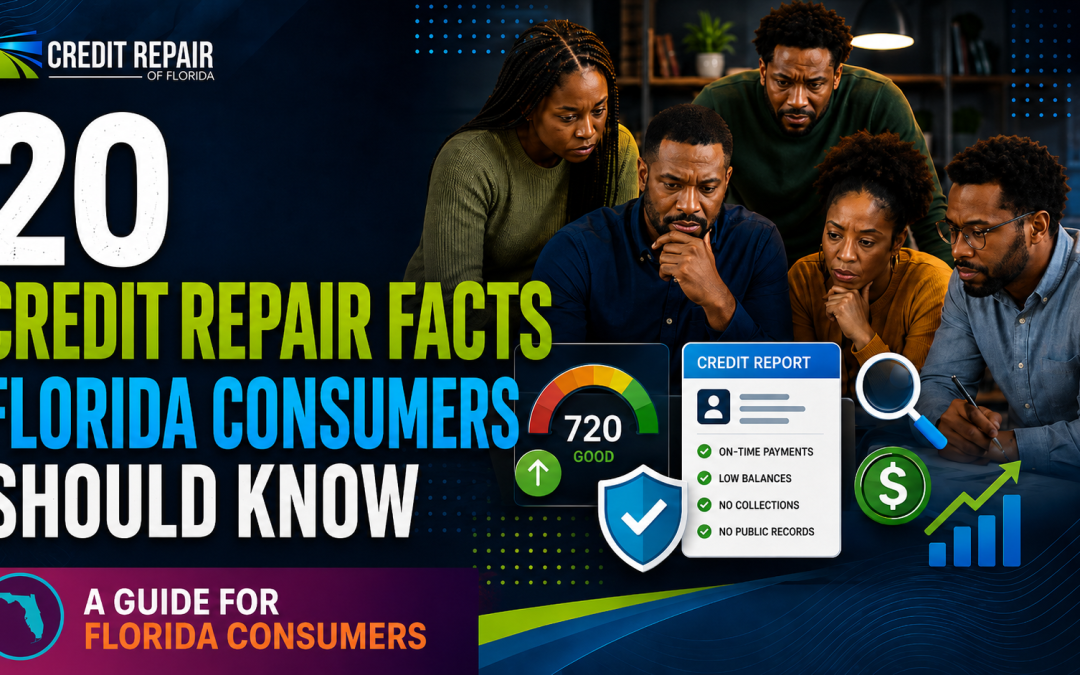
Understanding credit repair facts is crucial for making informed financial decisions.
Credit repair involves legal processes to dispute inaccurate, incomplete, or outdated information on credit reports.
Consumers have rights under federal laws to dispute incorrect information and must work with reputable credit repair companies.
Regularly checking credit reports can help identify errors, and disputes should be specific for effective resolution.
Long-term credit health relies on consistent financial habits, not just credit repair efforts.
Understanding credit repair facts can help you make smarter decisions when you are trying to improve your financial future. Many people do not think about credit until they need to buy a car, rent an apartment, apply for a mortgage, qualify for a credit card, or get approved for better loan terms. By then, inaccurate credit report information, late payments, collections, high balances, or identity theft issues may already be creating problems.
Credit repair is often misunderstood. Some people think it is a quick fix that can erase any negative item from a credit report. Others assume there is nothing they can do once negative information appears. The truth is somewhere in the middle. Credit repair is a legal process that focuses on reviewing credit reports, identifying questionable information, and taking steps to dispute information that may be inaccurate, incomplete, outdated, or unverifiable.
For Florida consumers, knowing how credit repair works is especially important. Your credit can affect major life decisions, including housing, transportation, insurance costs, and access to financing. Whether you live in Orlando, Tampa, Miami, Jacksonville, Fort Lauderdale, or anywhere else in Florida, understanding your rights can help you protect your financial reputation.
Below are 20 important credit repair facts every consumer should know before starting the process.
1. Credit Repair Starts With Your Credit Reports
Credit repair begins with your credit reports, not your credit score. Your credit score is calculated from the information in your credit file. If the information in your credit reports is inaccurate, incomplete, outdated, or unverifiable, it may affect the score a lender sees.
The three major credit bureaus are Equifax, Experian, and TransUnion. Each bureau may have slightly different information because creditors do not always report to all three. That is why reviewing only one report may not give you the full picture.
A complete credit repair review should look at all three credit reports. You may find that a collection appears on one report but not another, or that an account balance differs between bureaus. These differences matter because lenders may check one bureau, two bureaus, or all three depending on the type of application.
2. Credit Repair Is Legal
Credit repair is legal when it is done properly. Federal law gives consumers the right to dispute information on their credit reports that they believe is inaccurate or incomplete. This right applies whether you handle disputes yourself or work with a credit repair company.
However, legal credit repair must follow the rules. A company cannot mislead you, promise impossible results, or claim it can remove accurate negative information just because you do not like how it affects your score.
Legitimate credit repair focuses on accuracy, documentation, and consumer rights. It is not about creating a false credit identity, hiding from creditors, or using illegal tactics.
3. Credit Repair Cannot Remove Everything
One of the most important credit repair facts to understand is that credit repair has limits. It cannot erase accurate and timely negative information simply because it is damaging your credit score.
For example, if you missed payments and the creditor reported those payments correctly, a dispute may not remove them. If a collection account belongs to you and the information is accurate, it may remain on your credit report for the legally allowed reporting period.
Credit repair may help when information is wrong, outdated, duplicated, mixed with another person’s file, missing important details, or cannot be verified. The goal is not to delete all negative information. The goal is to make sure your credit reports are fair, accurate, and properly documented.
4. Credit Scores Are Based on Multiple Factors
Your credit score is not based on one single item. FICO scores generally consider five major categories: payment history, amounts owed, length of credit history, new credit, and credit mix.
Payment history is usually the largest factor. Late payments, charge-offs, and other missed-payment history can have a serious impact. Amounts owed, including credit card utilization, also plays a major role.
This is why credit repair and credit improvement are not always the same thing. Credit repair may address questionable information on your reports. Credit improvement may also require paying bills on time, lowering balances, avoiding unnecessary new accounts, and keeping older positive accounts open when appropriate.
5. Payment History Matters Most
Payment history is one of the most important parts of your credit profile. Lenders want to know whether you have paid past accounts on time. Even one late payment can affect your score, depending on the rest of your credit file.
A payment that is a few days late may trigger a late fee from the creditor, but creditors usually do not report it as late to the credit bureaus until it reaches at least 30 days past due. Once a late payment appears on your report, it can remain there for years if it is accurate.
If your issue is a recent late payment, bring the account current as quickly as possible. Then focus on preventing future missed payments. Automatic payments, calendar reminders, and budgeting tools may help reduce the risk of another late payment.
6. Credit Utilization Can Change Your Score Quickly
Credit utilization refers to how much of your available revolving credit you are using. For example, if you have a credit card with a $1,000 limit and a $700 balance, your utilization on that card is 70%.
High utilization can hurt your score, even if you make every payment on time. Many consumers focus only on whether they are current, but balances also matter. Lowering credit card balances may help your credit profile, especially if your cards are close to their limits.
For many people, reducing utilization is one of the most practical ways to work toward better credit health. A lower balance can also reduce interest costs and make monthly payments easier to manage.
7. Credit Report Errors Can Happen
Credit report errors are more common than many people realize. Mistakes can happen because of data entry problems, duplicate accounts, mixed files, identity theft, outdated information, or incorrect reporting by a creditor or collection agency.
Common credit report errors include accounts that do not belong to you, incorrect balances, wrong payment history, duplicate collection accounts, outdated negative items, incorrect personal information, and accounts still showing as open when they were closed.
Some errors may seem small, but they can still matter. An incorrect address may not directly lower your score, but it could indicate that your file contains information mixed with someone else’s. A wrong balance or false late payment may have a more direct impact.
8. You Can Check Your Credit Reports Weekly for Free
Consumers can access free weekly online credit reports from Equifax, Experian, and TransUnion through AnnualCreditReport.com. This is important because regular credit report reviews can help you catch problems early.
Checking your own credit reports does not hurt your credit score. This type of review is considered a soft inquiry. A hard inquiry usually happens when you apply for new credit and a lender checks your report as part of the application process.
If you are actively working on your credit, reviewing your reports regularly can help you track updates, identify errors, and watch for suspicious activity. You do not need to check every report every day, but you should review them often enough to understand what lenders may see.
9. You Have Rights Under the FCRA
The Fair Credit Reporting Act, often called the FCRA, gives consumers important rights related to credit reporting. These rights include the ability to dispute information you believe is inaccurate or incomplete.
When you file a dispute, the credit bureau must generally investigate the item and communicate with the company that provided the information. If the information cannot be verified or is found to be incorrect, it must be corrected or removed.
The FCRA does not guarantee that every disputed item will be deleted. It gives you the right to challenge questionable information and requires the credit reporting system to follow certain procedures.
10. Disputes Should Be Specific
A strong dispute should clearly explain what you believe is wrong and why. Generic disputes may be less effective because they do not give the credit bureau or furnisher enough information to investigate the issue.
For example, instead of saying, “This account is wrong,” you may need to explain that the balance is incorrect, the account does not belong to you, the payment history is inaccurate, the account is duplicated, or the date being reported is outdated.
Documentation can also help. Depending on the situation, useful documents may include payment confirmations, settlement letters, identity theft reports, court documents, creditor correspondence, account statements, or proof of address.
11. Credit Repair Takes Time
Credit repair is not instant. Credit bureaus generally have a specific investigation period after receiving a dispute, and some situations may take longer depending on the type of dispute and whether additional information is submitted.
Even after an item is corrected or removed, your score may not update immediately across every platform. Different credit monitoring apps, lenders, and scoring models may refresh information at different times.
Be cautious of anyone who promises a specific score increase within a specific number of days. No one can honestly guarantee that every consumer will see the same result. Your outcome depends on your credit history, the accuracy of the information, the type of items involved, and how the bureaus and furnishers respond.
12. Credit Repair and Credit Counseling Are Different
Credit repair and credit counseling are not the same service. Credit repair focuses on credit report accuracy and disputes. Credit counseling usually focuses on budgeting, debt management, and financial education.
A credit counselor may help you create a plan to manage debt, understand spending, or explore a debt management program. A credit repair company may help you review credit reports and address questionable credit reporting.
Some consumers may need both types of help. For example, a person may have credit report errors and also need a plan to manage current debt. Understanding the difference helps you choose the right support for your situation.
13. Debt Settlement Is Not Credit Repair
Debt settlement is also different from credit repair. Debt settlement involves negotiating with a creditor or collector to resolve a debt for less than the full amount owed. Credit repair involves reviewing and disputing questionable credit report information.
A settled account may still appear on your credit report. The account may show that it was settled for less than the full balance, depending on how the creditor reports it. That reporting can still affect your credit.
If you recently settled a debt, review your credit reports afterward. Make sure the account balance, status, and dates are being reported accurately. If the reporting is wrong, you may have the right to dispute it.
14. Identity Theft Can Damage Your Credit
Identity theft can create serious credit problems. Fraudulent accounts, unauthorized inquiries, and collection accounts from accounts you never opened can damage your credit file.
If you see accounts you do not recognize, act quickly. Review all three credit reports, contact the creditor, consider filing an identity theft report, and consider placing a fraud alert or credit freeze.
Identity theft credit repair may require more documentation than a standard dispute. Keeping records is important. Save letters, case numbers, police reports, FTC identity theft reports, and all communication with creditors and credit bureaus.
15. Accurate Negative Items Can Stay for Years
Many negative items can remain on a credit report for up to seven years. Some bankruptcy information may remain longer. The exact reporting period depends on the type of item and the law that applies.
This does not mean your credit cannot improve while negative information remains. New positive activity can help over time. Paying bills on time, lowering balances, and avoiding unnecessary new debt can support your credit profile.
Credit repair should not be viewed as the only solution. It is one part of a larger credit strategy. If negative items are accurate, the focus may need to shift toward rebuilding and maintaining positive habits.
16. Closing Accounts Can Sometimes Hurt
Some consumers believe closing old credit cards always helps their credit. That is not always true. Closing a revolving account can reduce your total available credit, which may increase your utilization ratio if you carry balances on other cards.
Closing an older account may also affect the overall age of your credit history over time. This does not mean you should never close an account. There may be good reasons to close an account, such as high fees, fraud concerns, or difficulty controlling spending.
Before closing an account, consider how it may affect your utilization, account age, and overall credit mix. If you are unsure, review your full credit profile before making the decision.
17. New Credit Applications Can Affect Your Score
When you apply for credit, the lender may perform a hard inquiry. A single inquiry may only have a small impact, but several applications in a short period can affect your score and make lenders view you as a higher risk.
This is especially important if you are preparing for a mortgage, auto loan, or other major financing. Applying for multiple credit cards shortly before a major loan application may not be the best strategy.
If your credit goal is tied to a major purchase, plan ahead. Focus on correcting credit report issues, lowering balances, and avoiding unnecessary applications before the lender reviews your file.
18. Local Credit Repair Help May Benefit Florida Consumers
Florida consumers may choose to work with a local credit repair company because they want guidance from a team familiar with the state’s communities, housing market, and consumer concerns.
A local company can help review your reports, explain possible dispute options, and help you organize documentation. However, location alone is not enough. You should also look for transparency, clear communication, legal compliance, and realistic expectations.
A trustworthy credit repair company should explain what it can and cannot do. It should not pressure you with false promises or guarantee a specific result.
19. Credit Repair Scams Are Real
Credit repair scams can harm consumers financially and legally. Be careful with companies or individuals who promise to remove all negative items, guarantee a specific score increase, tell you to create a new credit identity, or demand large upfront payments before doing any work.
You should also be cautious if someone tells you not to contact the credit bureaus, refuses to explain your rights, or avoids giving you a written agreement.
Legal credit repair is based on your rights as a consumer. It should never involve lying, using false information, or creating a fake identity. If something sounds too good to be true, it probably is.
20. Long-Term Credit Habits Matter Most
Credit repair can help address questionable information, but long-term credit health depends on consistent habits. Paying on time, keeping balances manageable, reviewing your reports, limiting unnecessary applications, and responding quickly to errors can all support your credit goals.
No credit repair company can replace good financial habits. Even if inaccurate information gets corrected, new late payments or high balances can continue to hurt your score.
Think of credit repair as part of a bigger plan. The goal is not only to fix past reporting problems. The goal is to build a more stable credit profile for the future.
When Should You Consider Credit Repair?
You may want to consider credit repair if your credit reports show accounts you do not recognize, incorrect late payments, duplicate collections, outdated negative items, wrong balances, mixed personal information, or accounts affected by identity theft.
You may also benefit from a credit report review before applying for a mortgage, auto loan, rental home, or other major financial product. Finding problems early may give you more time to address them before a lender makes a decision.
However, credit repair is not always the answer. If your reports are accurate but your score is low because of high balances or recent missed payments, you may need a credit-building strategy more than a dispute strategy.
How Credit Repair of Florida Can Help
At Credit Repair of Florida, we help consumers review their credit reports and better understand the information that may be affecting their credit. Our team focuses on identifying information that may be inaccurate, incomplete, outdated, or unverifiable and helping consumers take informed next steps.
We do not promise overnight results or guarantee a specific score increase. Every credit profile is different, and results depend on the facts of each situation. What we can do is help you understand your reports, organize the dispute process, and approach credit repair with a clear and realistic plan.
If you are unsure what is hurting your credit, a professional review may help you better understand where to start.
Final Thoughts on Credit Repair Facts
Credit repair is not magic, and it is not a loophole. It is a consumer rights process designed to help ensure that credit reports are accurate and fair. When used correctly, it can be an important tool for people dealing with credit report errors, identity theft, outdated information, or questionable account reporting.
The most important credit repair fact is this: your credit reports matter. They can affect lending decisions, interest rates, housing opportunities, and financial flexibility. Reviewing them regularly and correcting inaccurate information can help you protect your financial future.
If you believe your credit reports contain errors or questionable information, Credit Repair of Florida can help you review your options and take the next step with confidence.
Contact Credit Repair of Florida today to schedule a consultation and start reviewing your credit reports.
Frequently Asked Questions About Credit Repair
What is credit repair?
Credit repair is the process of reviewing your credit reports and addressing information that may be inaccurate, incomplete, outdated, duplicated, or unverifiable. This may include disputing questionable information with the credit bureaus or the companies furnishing the information.
Credit repair does not mean deleting accurate negative information simply because it hurts your score. The goal is to help ensure your credit reports are fair and accurate.
Is credit repair legal?
Yes, credit repair is legal when it is done properly. Consumers have the right to dispute information on their credit reports that they believe is inaccurate or incomplete. Credit repair companies must also follow federal rules under the Credit Repair Organizations Act, including restrictions on misleading claims and advance fees.
Can credit repair remove accurate negative items?
No. Accurate and timely negative information generally cannot be removed just because it affects your score. If a late payment, collection, charge-off, or other negative item is correct and still within the legal reporting period, it may remain on your credit report.
Credit repair may help when information is incorrect, outdated, duplicated, mixed with another consumer’s file, or cannot be verified.
Can I repair my credit myself?
Yes. Consumers can review their own credit reports and file disputes directly with the credit bureaus. Some people choose to handle the process on their own, while others prefer professional help because they want assistance reviewing reports, organizing documentation, and understanding possible next steps.
A credit repair company cannot legally do anything that you do not have the right to do yourself.
A free credit repair consultation in Orlando can be a useful first step if collections, late payments, or unfamiliar accounts are standing between you and an apartment, a car loan, or a lower interest rate. It can also turn into a high-pressure sales pitch if the conversation focuses on urgency and guarantees instead of your actual credit report.
Orlando’s rental market is competitive, and many landlords, lenders, and employers in Central Florida review credit as part of their decision process. That’s worth knowing before you book a consultation. This guide covers what a free consultation includes, what your rights are under federal and Florida law, and what no consultant — including one at Credit Repair of Florida — can honestly promise you.
Last updated: June 26, 2026
Estimated reading time: 8 minutes
Key Takeaways
“Free” describes the initial conversation, not ongoing credit repair services.
Federal law requires every credit repair organization to give you a specific written rights disclosure before any contract is signed.
No consultant can guarantee deletions, a specific score increase, or loan approval.
You can dispute credit report errors yourself, for free, without hiring anyone.
Florida gives you 5 days to cancel a covered contract; federal law separately gives you 3 business days.
What Happens During a Free Credit Repair Consultation
A consultation is a conversation, not a service. Expect to discuss what’s currently on your credit reports, what you’re trying to accomplish — a mortgage pre-approval, a rental application, a lower auto rate — and whether the information on your reports appears accurate. A responsible consultant explains the dispute process in plain terms and is upfront about what is and isn’t included at no cost.
Not every consultation includes a full three-bureau review. Some cover one report; others walk through your goals without pulling anything yet. Ask directly what’s included before you assume.
Why Orlando Residents Consider Credit Repair
Central Florida’s rental and housing market has grown more competitive over the past several years. Landlords in Orange County frequently screen applicants’ credit alongside income and rental history. A denied application, a high security deposit, or an unexpectedly high loan rate is often what prompts someone to book a consultation in the first place.
Local familiarity can help a consultant explain how Orlando-area landlords and lenders typically use credit information, but it does not change what federal law allows a credit repair company to do. The legal limits described below apply the same way whether you’re in Orlando, Miami, or anywhere else in Florida.
Your Rights Under Federal Law
Federal law requires every credit repair organization to give you a written statement before you sign a contract. We’re reproducing it in full below, so you can read it before sitting down with us or with anyone else.
The Legally Required Disclosure
Consumer Credit File Rights Under State and Federal Law
“You have a right to dispute inaccurate information in your credit report by contacting the credit bureau directly. However, neither you nor any ‘credit repair’ company or credit repair organization has the right to have accurate, current, and verifiable information removed from your credit report. The credit bureau must remove accurate, negative information from your report only if it is over 7 years old. Bankruptcy information can be reported for 10 years.
“You have a right to obtain a copy of your credit report from a credit bureau. You may be charged a reasonable fee. There is no fee, however, if you have been turned down for credit, employment, insurance, or a rental dwelling because of information in your credit report within the preceding 60 days. The credit bureau must provide someone to help you interpret the information in your credit file. You are entitled to receive a free copy of your credit report if you are unemployed and intend to apply for employment in the next 60 days, if you are a recipient of public welfare assistance, or if you have reason to believe that there is inaccurate information in your credit report due to fraud.
“You have a right to sue a credit repair organization that violates the Credit Repair Organization Act. This law prohibits deceptive practices by credit repair organizations.
“You have the right to cancel your contract with any credit repair organization for any reason within 3 business days from the date you signed it.
“Credit bureaus are required to follow reasonable procedures to ensure that the information they report is accurate. However, mistakes may occur.
“You may, on your own, notify a credit bureau in writing that you dispute the accuracy of information in your credit file. The credit bureau must then reinvestigate and modify or remove inaccurate or incomplete information. The credit bureau may not charge any fee for this service. Any pertinent information and copies of all documents you have concerning an error should be given to the credit bureau.
“If the credit bureau’s reinvestigation does not resolve the dispute to your satisfaction, you may send a brief statement to the credit bureau, to be kept in your file, explaining why you think the record is inaccurate. The credit bureau must include a summary of your statement about disputed information with any report it issues about you.
“The Federal Trade Commission regulates credit bureaus and credit repair organizations. For more information contact: The Public Reference Branch, Federal Trade Commission, Washington, D.C. 20580.”
Source: 15 U.S.C. §1679c, the disclosure required under the federal Credit Repair Organizations Act.
What This Means in Plain English
You already have the right to dispute credit report errors yourself, for free, directly with Equifax, Experian, or TransUnion. Hiring a credit repair company grants no extra legal power to remove accurate information — no company, including ours, can do that.
What a Consultation Cannot Promise
No responsible consultant can guarantee the deletion of a specific account, a precise score increase, mortgage or rental approval, or completion by a fixed date. No one can remove accurate, timely negative information from your report simply because it’s unfavorable — the disclosure above says this directly. If someone tells you otherwise, treat it as a warning sign, not reassurance.
A consultation can reasonably help you understand what’s on your reports, which items might genuinely be inaccurate or outdated, and what your options are — including options that don’t involve paying anyone.
Cancellation Rights and Payment Rules
If a consultation leads to a signed agreement, two separate cancellation windows apply. Florida law gives you 5 days to cancel a covered credit repair contract. Federal CROA separately gives you 3 business days to cancel a covered contract, for any reason, without penalty — the disclosure above states this directly.
Federal law also restricts a covered credit repair organization from charging or receiving payment before it fully performs the agreed service. Florida law regulates advance payment too, through a limited surety-bond and trust-account framework. Ask exactly what completed service triggers each charge — and get the answer in writing.
How to Prepare for Your Consultation
Pull your reports first at AnnualCreditReport.com, the only federally authorized source for free reports, so you’re not relying on a company’s version of your own file.
Write down specific items that look wrong — a wrong balance, an account you don’t recognize, a payment marked late that you paid on time.
Decide your goal ahead of time: a rental application, a car loan, a mortgage pre-approval — it changes what’s actually relevant to discuss.
Bring your questions in writing, and ask for written answers.
Warning Signs to Watch For
Guaranteed deletions, a guaranteed score increase, or a guaranteed approval.
Pressure to sign or pay before the consultation ends.
An offer involving a CPN or “new credit identity” — the FTC warns these numbers may be stolen Social Security numbers.
Instructions to dispute every negative item regardless of whether it’s accurate.
No written contract, unclear fees, or refusal to explain cancellation rights.
Credit Repair of Florida can walk through your credit report information with you and explain your realistic options. We do not guarantee deletions, approvals, or a specific score increase — and as the disclosure above makes clear, no legitimate company can.
Is a free credit repair consultation in Orlando really free?
The initial conversation should carry no charge when it’s advertised as free. Ongoing credit repair, monitoring, or report-access services may cost money — confirm the boundary before the appointment.
Does the consultation review all three credit reports?
Not necessarily. Ask directly whether the provider reviews one report, all three, or only discusses your goals without pulling a report yet.
Can I dispute credit report errors myself instead of hiring anyone?
Yes. The federally required disclosure above states this directly — you can dispute inaccurate information with the credit bureau yourself, for free, at any time.
What cancellation rights do I have if I sign a contract?
Florida law provides a 5-day cancellation right for covered contracts. Federal CROA separately provides 3 business days. Follow the written cancellation instructions and keep proof of delivery.
Can a company remove accurate negative information from my report?
No. Accurate, current, and verifiable information generally cannot be removed simply because it’s unfavorable — negative information can be reported for up to 7 years, and bankruptcy for up to 10.
This article is provided for general educational purposes and is not legal, tax, or financial advice. Laws and requirements may change, and their application depends on the facts. Consult a qualified attorney for advice about a specific situation.
Are you planning to buy your dream home or car? Credit repair companies in Florida help you in Buying a dream home or the ideal car is a great milestone in your life. These achievements make you feel important and successful as an individual. But what if a low credit score holds you back from achieving these goals? There are many reasons for financial institutions to deny you credit to buy your dream home or car. Even outdated or incorrect information can prevent you from taking a mortgage or car loan to help achieve your goals. That’s where credit repair plays an important part. Trying to repair one’s credit could be challenging in today’s competitive market environment. A reputable credit repair service can help repair your credit and achieve your goals. The Florida Department and the Attorney General oversee the enforcement of the Florida Credit Service Organizations Act (FCSOA), which aims to protect consumers from fraudulent practices in the credit repair industry. Here are some of the advantages of working with the best credit repair company or a reputable credit repair service in Florida to repair your credit.
Florida law provides additional safeguards beyond federal regulations, ensuring transparency and accountability from credit repair companies. Credit repair organizations are required to provide consumers with an information statement that includes details such as the name, address, and account number of the trust account depository or surety bond issuer.
Introduction to Credit Repair Services
Credit repair services are designed to help individuals improve the quaity of their credit files via a dispute process that may help to improve their credit scores and their financial stability. These services specialize in analying, identifying, disputing, and errors, omissions, and unverifiable items on credit reports, which can significantly impact credit scores. Poor credit scores, often referred to as bad credit, can limit financial opportunities such as securing loans or employment. With the help of a reputable credit repair company, individuals can dispute negative credit information which could correct inaccurate items which could lead to achieving a better credit score.
The best credit repair companies offer a range of services, including credit report analysis, credit repair disputing, and credit monitoring, amongst others to help individuals achieve their credit goals. By addressing these issues, performing credit repair can pave the way for better loan terms, lower interest rates, and enhanced financial opportunities.
Understanding Credit Repair
Credit repair is the process of identifying and disputing errors, inaccuracies, or unverifiable information on credit reports. This may help to improve credit scores and overall financial health. Credit repair services, offered by credit repair companies, specialize in helping individuals dispute their credit by addressing questionable credit information, disputing errors to the transunion, Experian, Equifax, and data furnishers / creditors. The Fair Credit Reporting Act (FCRA) regulates credit reporting and provides consumers with the right to access their credit reports, dispute inaccuracies, and receive free annual reports. Credit repair companies, such as Credit Repair of Florida, use their expertise and knowledge of consumer credit to help individuals navigate the credit repair process.
Understanding Credit Report
A credit report is a detailed record of an individual’s credit history, including information about their credit accounts, payment history, and credit inquiries. The three major credit bureaus - Equifax, Experian, and TransUnion - maintain these reports, which are used by lenders and creditors to evaluate creditworthiness. Understanding credit reports is crucial for identifying errors, inaccuracies, and negative items that can harm credit scores. Credit repair services can help individuals obtain and review their credit reports, identify areas for improvement, and develop a plan to repair their credit. By regularly monitoring and understanding your credit report, you can take proactive steps to maintain a healthy credit profile and avoid potential pitfalls.
Credit Report Analysis
Credit report analysis is the initial step in the credit repair process. It involves a thorough review of credit reports from the three major credit bureaus - Equifax, Experian, and TransUnion - to identify errors, inaccuracies, and negative items that may be affecting your credit scores. A detailed credit report analysis helps individuals understand their credit situation and develop a personalized plan to improve their credit scores. Handling dispute paperwork is a key service that allows clients to receive updates on the status of their disputes and improve their overall credit standing. Reputable credit repair companies, such as Credit Repair of Florida, offer comprehensive credit report analysis as part of their services. They employ expert credit analysts and utilize advanced technology to meticulously review credit reports and pinpoint areas for improvement. By analyzing credit reports, individuals can identify and dispute inaccurate information with the hope of enhancing their overall credit health.
Credit Monitoring and Repair
Credit monitoring and repair are essential services offered by credit repair companies to help individuals maintain and improve their credit health. Credit monitoring involves continuously tracking credit reports and scores to detect any changes or errors, while credit repair focuses on disputing, correcting, or removing inaccurate negative information from credit reports. Companies like Credit Repair of Florida provide robust credit monitoring and credit repair services, leveraging advanced technology and expert credit analysts to keep a close watch on credit reports and identify any discrepancies. By helping you dispute errors in your credit reports, individuals can improve their credit health, achieve their financial goals, and protect themselves from identity theft, which can significantly impact credit scores.
Managing communication with collection agencies is important during the dispute process, and clients are encouraged to request written correspondence to validate debts while pursuing disputes with creditors.
Credit Repair Process
The credit repair process typically begins with a free initial consultation, where a credit repair specialist reviews an individual’s credit report and identifies areas for improvement. Credit repair agencies are mandated to provide clients with a detailed information statement, as required by the Florida Credit Service Organizations Act. The specialist will then create a personalized plan to dispute negative items, remove inaccurate information, and work towards improving the individual’s credit score. This may involve sending dispute letters to credit bureaus, negotiating with creditors, and providing educational resources to help individuals manage their credit effectively. The Federal Trade Commission enforces the terms of both the Credit Repair Organizations Act (CROA) and the Fair Credit Reporting Act (FCRA), ensuring that credit repair firms adhere to federal regulations. Specialized attorneys in consumer law aid in navigating credit inaccuracies and unfair reporting by creditors, ensuring compliance with legal standards while advocating for clients’ financial improvement. Credit repair companies may also offer additional services, such as credit monitoring and identity theft protection, to help individuals maintain good credit habits and protect their financial information. By following a structured credit repair process, individuals can systematically address issues on their credit reports and work towards achieving their credit goals.
Benefits Of Credit Repair
A well trained and experienced credit repair organization is your best bet when you want to correct your credit in Florida . Late payments can negatively impact your credit scores, making it harder to secure loans, rent properties, and often resulting in higher interest rates from creditors. You can sit back and relax while the credit repair company deals with the relevant financial institutions and disputes inconsistencies on your credit report. Credit repair services focus on improving the quality and correctness of your credit file by disputing questionable items on your credit reports.
A professional service provider will look through all of your credit issues and consult you on how and why you should resolve them efficiently. Most employers look at the credit history of the potential employee before hiring them for the job. If you are planning to apply for your first job, a new job, or you want a better job, you should first take care of your credit score. Make sure to work with a reliable credit service provider in FL to dispute your credit before applying for a job. Your chances of buying your dream home or car will significantly improve when you work with a reliable credit repair company in FL and repair your credit before approaching the financial institution or bank to get a loan.
Benefits of Working with Credit Repair of Florida
Working with Credit Repair of Florida offers numerous benefits for individuals with poor credit scores. Credit Repair Of Florida possess the expertise and experience to analyze credit reports, identify errors and inaccuracies, and develop personalized plans to improve the quality of your credit report which could impact your credit scores. They also provide valuable educational resources and guidance on maintaining good credit habits and avoiding common credit mistakes. Additionally, credit pros help individuals navigate the complex credit repair process and ensure their rights are protected under the Fair Credit Reporting Act. By partnering with credit pros, individuals can improve their credit scores, achieve their financial goals, and enjoy better financial stability. Moreover, credit pros can help individuals avoid costly mistakes, such as overpaying for credit repair services or falling victim to fraudulent or deceptive practices. While standard services may suffice, some users may benefit from the additional offerings found in the more expensive packages, which typically include features such as FICO score updates, credit counseling, and identity theft protection.
What to Expect from a Credit Repair Service
When obtaining credit repair services, individuals can expect a thorough analysis of their credit reports from the major credit bureaus, including Equifax, Experian, and TransUnion. A reputable credit repair company will provide a free consultation to discuss the individual’s credit situation, identify areas for improvement, and create a personalized plan to address negative items and errors. The credit repair process typically involves disputing inaccurate information, negotiating with creditors, and monitoring credit reports to ensure accuracy and fairness. Credit repair companies may also offer additional services, such as credit monitoring, identity theft protection, and educational resources, to help individuals maintain good credit habits and achieve long-term financial stability.
How To Find A Good Credit Repair Service?
With dozens of credit repair companies in Florida, choosing the best service isn’t easy. Your research becomes important when choosing a reliable credit repair service in the area. The cost and range of services provided by credit repair companies can vary significantly, urging potential customers to assess which service level aligns with their specific needs. Most companies in the credit repair industry begin with free initial consultations to assess clients' needs and offer subscription-based services for ongoing assistance. To start the process, you need to obtain credit repair services from a reputable company. A reliable credit repair service will go through your credit reports from each credit reporting bureau and review all the negative information and errors in these reports. They will request the bureaus and data furnisher / creditors to correct or verify these errors to resolve any disputes. The Federal Trade Commission (FTC) enforces federal regulations related to credit repair, ensuring compliance with laws like the Credit Repair Organizations Act (CROA) and the Fair Credit Reporting Act (FCRA). Dealing with credit bureaus and creditors is best left to professionals. They have the relevant experience, contacts, and negotiation skills to do a better job in this regard. That’s why you need to rely on a professional credit repair service in FL to repair your credit and improve the credit score as a result.
Credit Repair Cost and Pricing
The cost of credit repair services can vary depending on the company, the level of service, and the individual’s credit situation. Most credit repair companies charge a monthly fee, which can range from $79 to $199 per month, depending on the services provided. Comprehensive credit repair service packages may include extra services such as disputing to creditors and regulatory agencies in conjunction to the Transunion, Equifax, and Experian. Individuals with a poor credit score face challenges that can be addressed through tailored credit restoration services, focusing on creating customized action plans to improve their credit standing. It’s essential to research and compare prices, services, and contract requirements before choosing a credit repair company. Reputable companies will provide a written contract, disclose their fees and services, and offer a full refund if they fail to perform the work described in there credit repair agreements. By understanding the cost structure and what each credit repair service package includes, you can make an informed decision that aligns with your financial needs and goals.
State Regulations and Compliance
Credit repair companies must comply with federal and state regulations, including the Fair Credit Reporting Act (FCRA) and the Credit Repair Organizations Act (CROA). These laws protect consumers from fraudulent or deceptive practices, require credit repair companies to provide written contracts and disclose their fees and services, and prohibit companies from making false or misleading claims. State law complements federal regulations to provide consumers with additional protections against unfair business practices. In Florida, credit repair companies must also comply with state regulations, such as the Florida Credit Service Organizations Act, which give credit repair companies the option to have a $10,000 credit services a surety bond. Credit repair organizations in Florida must provide consumers with clear documentation regarding the trust account depository, ensuring transparency and accountability. These firms must disclose the name, address, and account number of the trust account depository or surety bond issuer in their information statements. The Florida statute offers additional consumer protections and outlines specific legal requirements that credit repair organizations must adhere to, ensuring transparency and fairness in the industry. Reputable credit repair companies will be familiar with these regulations and ensure that their practices comply with federal and state laws. By choosing a company that adheres to these regulations, you can have confidence in the legitimacy and effectiveness of the credit repair services you receive.
Tips To Choose A Good Credit Repair Company In FL
Steer clear of credit companies that:
Don’t offer a contract with corresponding state disclosure documents for you to sign.
The contract should explain clearly what / when credit repair services are completed and corresponding invoices and payments are required for services rendered.
Don’t provide you with Notice of Cancellation.
Don’t provide you with Federal Disclosure Documents.
Demand an complete upfront payment.
Have unresolved complaints against them.
Promise a quick fixes that sound to good to be true.
Do not provide you with online access to monitor your credit repair progress
When choosing a reputable service, consider credit repair agencies that provide clear contracts, transparent pricing models, and adhere to federal and state regulations. These agencies typically offer monthly or pay per delete service subscriptions that include services to resolve discrepancies on your credit report, making the process less daunting.
Local factors influence credit challenges and the availability of services, suggesting that residents of areas like West Palm Beach can benefit from specialized credit repair options tailored to their community.
Credit repair organizations must maintain a copy of each issued dispute letter, which do not need to be personally signed by the consumer.
Maintaining a good credit score requires ongoing effort and attention to credit habits. Individuals can maintain good credit by making timely payments, keeping credit utilization low, and avoiding new credit inquiries. Credit monitoring services, offered by credit repair companies, can help individuals stay on top of their credit reports and detect potential issues early. Additionally, individuals can take steps to protect their identity and prevent identity theft, such as monitoring their credit reports and using secure online practices. By following good credit habits and working with a reputable credit repair company, individuals can maintain good credit scores, achieve financial stability, and enjoy better financial health.